
Why AI projects come apart on the data underneath rather than the model on top — and what a practical governance layer looks like once you strip out the committees.
| QUICK ANSWER
Data governance for AI means being able to answer four questions about every dataset a model reads: where it came from, whether it is accurate and current, who may use it, and what happens to it over time. AI raises the stakes because it spreads bad data across every prediction, makes traceability far harder, and can leak restricted data through its own answers. Start with the sources that feed the AI, catalog origin and freshness, name an owner, set access rules, and automate drift checks. |
Ask a room full of executives whether they trust their AI outputs, and most will hesitate. Ask them whether they have data governance in place, and most will change the subject. Those two answers are the same answer.
Governance has an image problem. It sounds like committees, policy documents nobody reads, and a compliance team saying no. So teams rushing to ship AI treat it as bureaucracy to deal with later, and they pour their energy into models and prompts instead. Then the AI starts producing outputs that are subtly, confidently wrong, and the investigation always ends in the same place: the data underneath was never governed, so nobody could say where it came from, whether it was current, or who was allowed to use it. The model didn’t fail. The ungoverned data did.
This is worth getting right, because governance is not the tax you pay for AI. It’s the thing that makes AI trustworthy enough to use.
What governance actually means here
Four plain questions — and why fluent, confident output makes them urgent
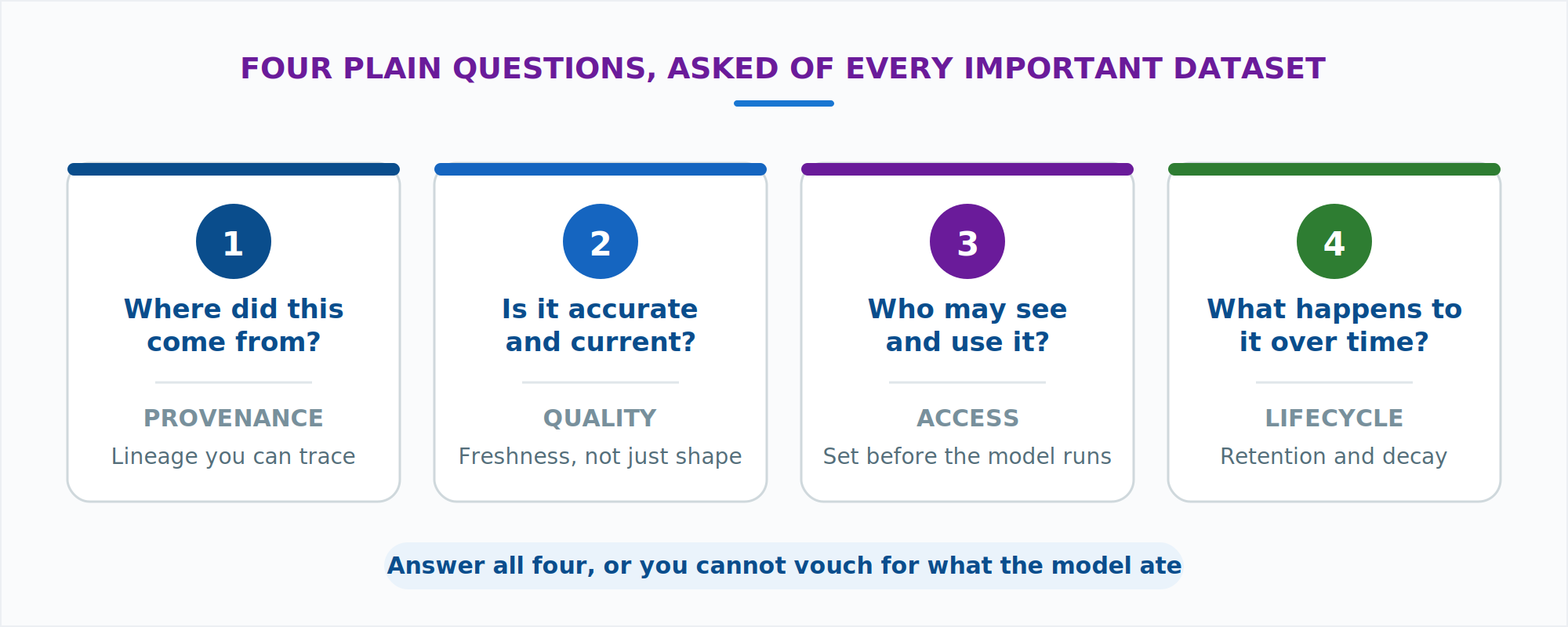
Strip away the jargon and data governance answers four plain questions about every important dataset. Where did this come from? Is it accurate and current? Who is allowed to see and use it? And what happens to it over time?
WHAT GOVERNANCE ACTUALLY ASKS
Four questions asked of every dataset a model will read. Answer all four, or you cannot vouch for the input.
None of that is exotic. It’s the difference between a spreadsheet someone emailed around and a dataset you’d stake a business decision on. For traditional reporting, weak governance produced a bad dashboard someone eventually caught. For AI, the stakes change, because a model will ingest whatever you feed it and generate fluent, plausible output regardless of whether the input was garbage. It doesn’t flinch at stale data or flag a field it wasn’t supposed to use. It just answers, confidently, and the confidence is the danger.
Why AI raises the stakes
Scale, traceability and access control all shift when a model is in the loop
Three things change when AI enters the picture.
Scale changes. A governance gap that affected one monthly report now affects every prediction a model makes, thousands of times a day, silently. The blast radius of bad data grows by orders of magnitude.
Traceability gets harder. When a model produces a wrong answer, “why did it say that?” is a genuinely difficult question, and it’s nearly impossible to answer if you can’t trace which data shaped the output. Governance is what makes an AI decision auditable after the fact, which matters more every quarter as regulators start asking exactly that question.
And access control becomes a live risk. Feed a model data that some users shouldn’t see, and the model can leak it through its answers in ways a permissions table never would. Governing who can use which data, and for what, stops your AI from becoming an accidental disclosure engine.
THE SAME GAP, BEFORE AND AFTER AI
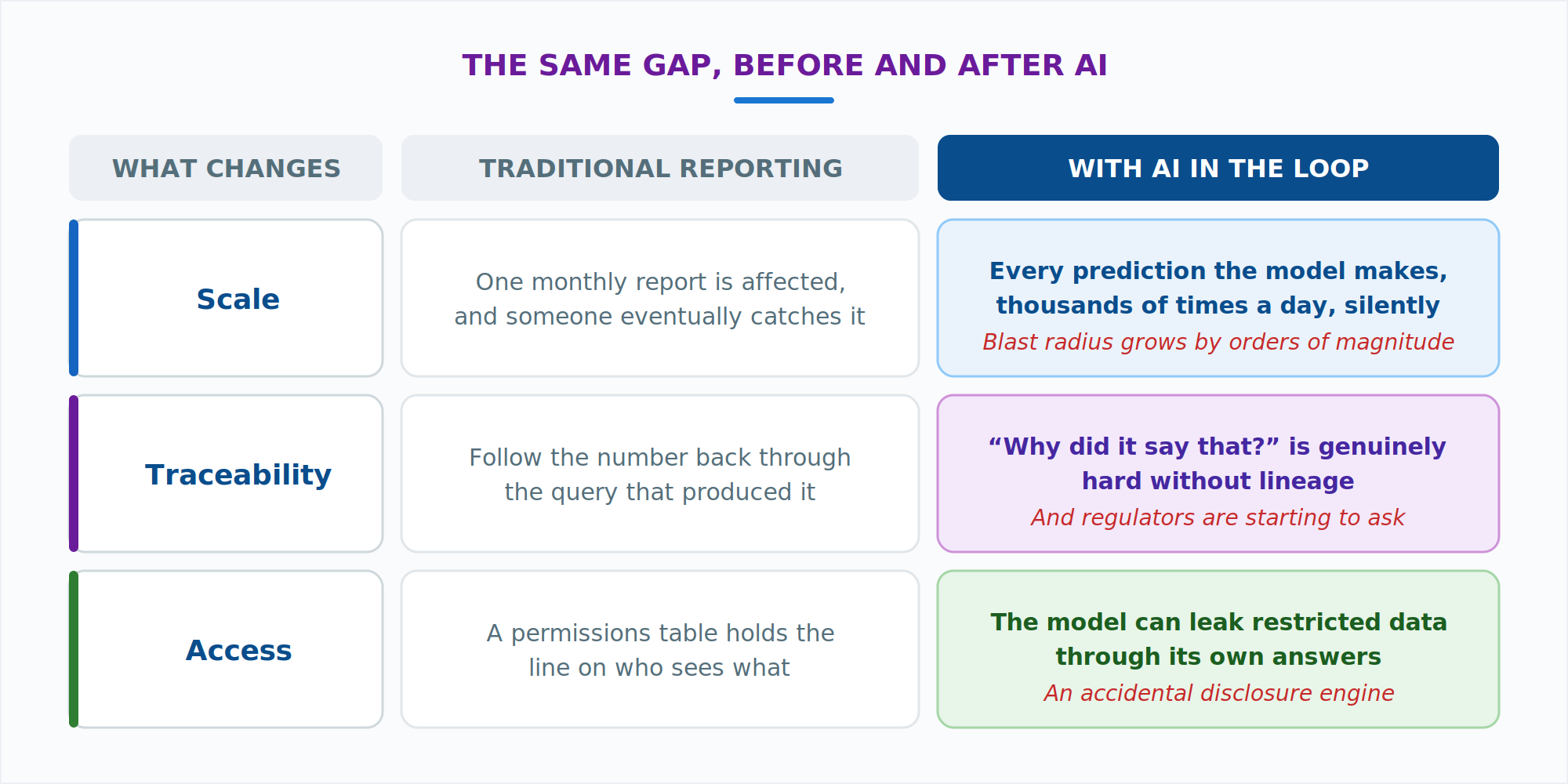
Each governance weakness carries a different blast radius once a model is consuming the data.
Governance without the bureaucracy
The lightweight version: scope it to what feeds the AI, then automate it
The reason governance gets skipped is that people imagine the heavyweight version — a year of policy work before anyone ships anything. That version deserves to be skipped. The practical version looks different and starts small.
Two versions of the same word
| THE VERSION PEOPLE IMAGINE | THE VERSION THAT WORKS | |
| Scope | Everything the organisation owns, catalogued first | Only the sources that actually feed the AI |
| Timeline | A year of policy work before anyone ships | Starts small, and runs alongside the build |
| Output | Documents, committees and sign-off gates | Lineage, freshness and access tracked as data flows |
| Feels like | A meeting you have to schedule | A property of the pipeline that is simply true |
Begin with the data that actually feeds your AI, not everything you own. Catalog those sources, record where each comes from and how fresh it is, and assign someone who owns the answer when a question arises. Set access rules on the sensitive fields before a model ever touches them, not after. Add automated quality checks that flag when a source drifts out of its expected shape, so problems surface as events rather than as a slow decline nobody noticed. This is where mature data engineering services and governance tooling earn their place: they make these checks routine instead of heroic.
THE PRACTICAL VERSION, IN ORDER
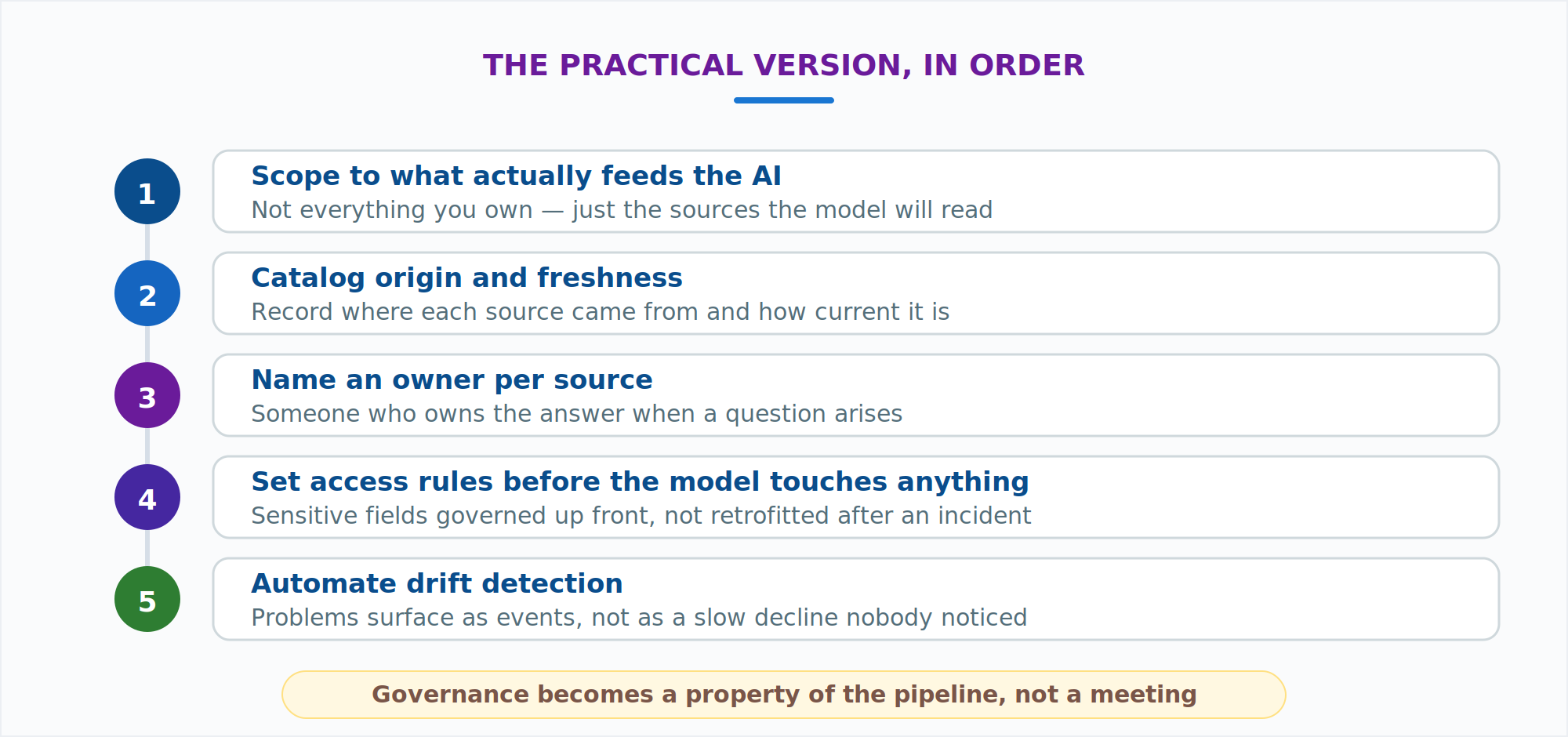
Five steps, scoped deliberately narrow, that make governance routine instead of heroic.
The point is to make governance a property of the pipeline rather than a meeting. When lineage, freshness, and access are tracked automatically as data flows, governance stops being something you schedule and becomes something that’s just true.
The payoff is trust you can prove
Explainable answers — and where the business value actually hides
Good governance doesn’t announce itself. Its reward is quiet: an AI system whose answers you can explain, defend, and stand behind when someone asks how it reached a conclusion.
That’s also where the business value hides. The organizations getting real returns from data invest heavily in turning raw, messy inputs into clean, governed, decision-ready information — which is exactly what serious business intelligence services are built to do. The ones struggling are trying to run AI on data they can’t vouch for, and paying for it in outputs they can’t trust.
Skip governance and you can still ship something. It’ll demo well. It’ll just never be something you can fully rely on, because you’ll never be able to answer the one question that matters: how do you know this is right? Build the governance in, and you can answer it every time. For an AI system, that answer is the whole game.
| KEY TAKEAWAYS | |
| 1 | The model rarely fails first — the ungoverned data underneath it does |
| 2 | AI multiplies every gap: scale, traceability and access control all get harder |
| 3 | Govern what feeds the AI first; the whole-estate version is the one that gets skipped |
| 4 | Track lineage, freshness and access in the pipeline so governance is true, not scheduled |
Frequently asked questions
What is data governance for AI?
Data governance for AI is the practice of being able to answer four plain questions about every dataset a model reads: where it came from, whether it is accurate and current, who is allowed to see and use it, and what happens to it over time. Without those answers, nobody can say whether an AI output rests on solid ground.
Why does AI raise the stakes on data governance?
Three things change. Scale: a gap that once affected one monthly report now affects every prediction a model makes, thousands of times a day. Traceability: explaining why a model produced a particular answer is near impossible without lineage. Access: a model can surface restricted data through its answers in ways a permissions table never would.
Where should a team start if it has no data governance at all?
Start with the data that actually feeds your AI rather than everything the organisation owns. Catalog those sources, record their origin and freshness, assign an owner for each, set access rules on sensitive fields before a model touches them, and add automated checks that flag when a source drifts out of its expected shape.
Can weak data governance cause an AI system to leak sensitive data?
Yes. If a model is trained on or given access to data that some users should not see, it can reveal that information through its generated answers, bypassing the controls a conventional permissions layer would enforce. Governing which data may be used, and for what, is what prevents an AI system from becoming an accidental disclosure channel.
Does data governance slow AI projects down?
The heavyweight interpretation does, which is why it gets skipped. The practical version runs alongside delivery: scoped to the AI’s own inputs, automated inside the pipeline rather than enforced in meetings, and built so lineage, freshness and access are tracked as data flows rather than documented after the fact.
| BEFORE YOU SHIP THE MODEL
Pick one dataset your AI already reads and try to answer all four questions about it: where it came from, how current it is, who is permitted to use it, and what happens to it over time. If any of those answers takes more than a few minutes to find, that gap is already in production. |