
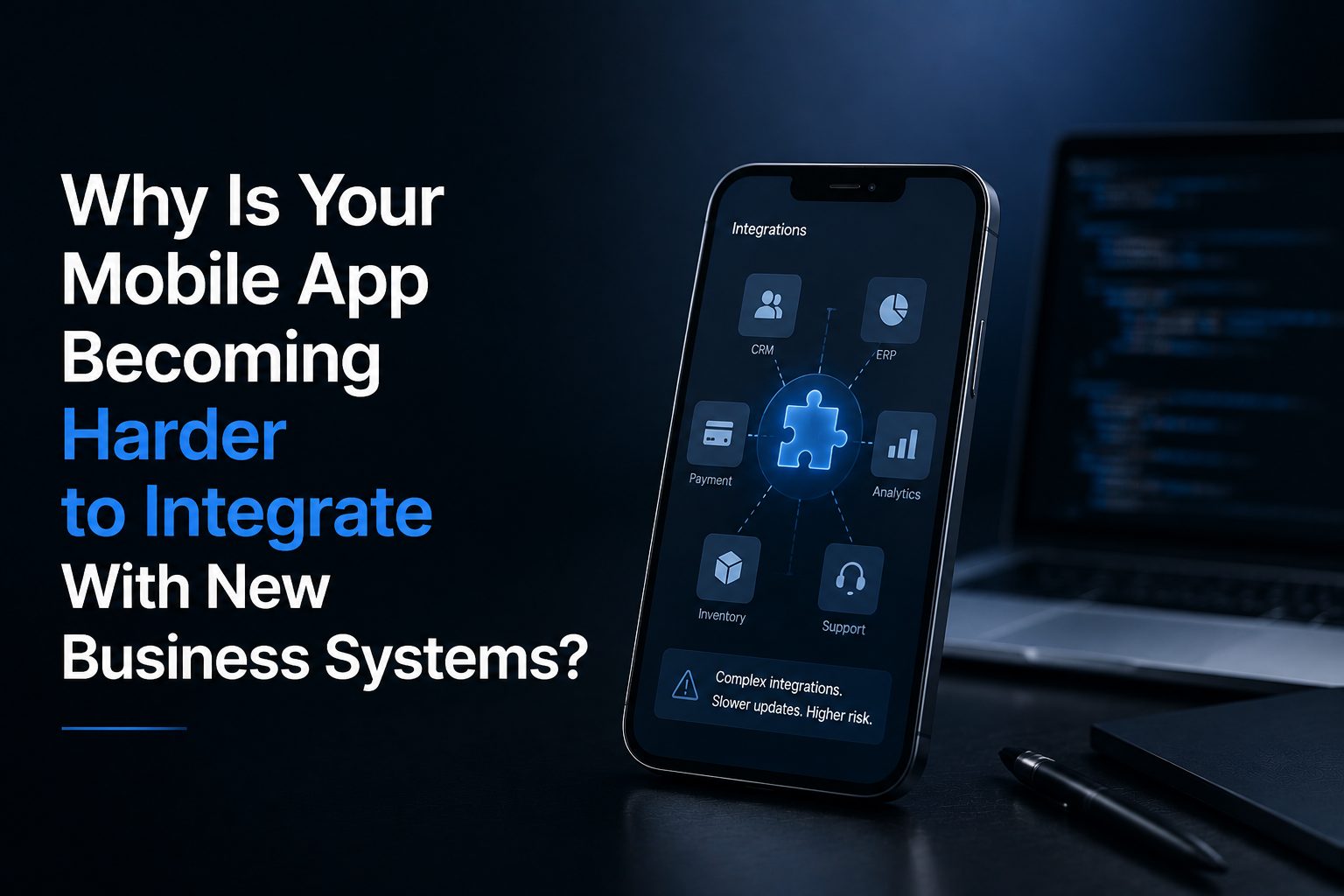
Most companies do not notice this problem until it costs them a quarter. A new CRM gets approved. A payment processor is swapped. A warehouse platform is upgraded. Then someone asks a reasonable question: how quickly can the mobile app connect to it?
The answer used to be a few weeks. Now it is a few months, and the estimate keeps slipping. The app still works. Customers still use it. But every new system it has to talk to costs more than the last one did.
That pattern is rarely a mobile problem. It is an architecture problem that mobile exposes first, because the app sits closest to the customer and furthest from the systems that actually run the business. Teams that commission custom mobile application development services without a clear picture of how the app will exchange data with finance, logistics, support and analytics tools over the next five years tend to accumulate integration debt quietly, release after release.
Integration Cost Is the Real Scalability Signal
Scalability is usually framed as a traffic question. How many concurrent users can the app handle on launch day? That matters, but it is not what constrains most growing businesses.
The more revealing question is different: when the business adopts a new system, how much of the existing app has to change? In a well-structured platform, very little. In a poorly structured one, a single integration touches authentication, data models, business logic and the interface all at once.
Integration difficulty is therefore a better early warning signal than server load. It tells you whether your technology can absorb change or merely survive it. Organizations that treat custom software development services as a long-term architectural commitment rather than a one-time build tend to keep that cost flat as they scale. NewAgeSysIT, a New Jersey based development firm serving enterprises across the United States, works with companies at exactly this inflection point.
What an Integration-Ready Application Actually Looks Like
Five characteristics separate applications that grow gracefully from those that harden into liabilities.
Scalability in this context means structural elasticity, not just capacity. The system should accommodate a new data source without a rewrite of everything downstream.
Security becomes the hidden tax on integration. Every connected system introduces a new trust boundary. Applications built with centralized identity, token-based access and clear permission models can onboard a partner system in days. Applications with credentials scattered across services cannot.
Performance degrades in unexpected ways once integrations multiply. An app that responds instantly in isolation can stall when it waits synchronously on three external systems. Asynchronous patterns and caching are what preserve responsiveness under real conditions.
Reliability is about failure isolation. When a third-party inventory service goes down, does your checkout flow fail with it, or does it degrade gracefully? Mature systems assume dependencies will break.
Integration capability is the sum of the other four. It reflects whether the application was designed as a participant in a broader ecosystem or as a self-contained product that later had connections bolted onto it.
The Pillars That Keep Integration Affordable
Modular architecture. The monolith versus microservices debate is often argued at the wrong altitude. The practical issue is coupling. A modular system, whether it runs as several services or one well-partitioned application, lets teams change the order module without touching the customer profile module. Full microservices bring operational complexity that many mid-sized businesses are not staffed for. A modular monolith with clean internal boundaries is frequently the smarter intermediate step.
Cloud-native development. Managed messaging, API gateways and event streams turn integration from custom code into configuration. That shift matters because it moves integration work from your engineering backlog into your infrastructure layer, where it is cheaper and more repeatable.
Data-driven decision making. Integration exists to move data somewhere useful. If your app cannot produce clean, consistently structured events, connecting it to a BI platform or analytics warehouse becomes an expensive translation exercise. Data quality at the source determines what your reporting can do later.
Automation and AI readiness. AI capability depends almost entirely on data access. Companies struggling to connect an AI feature to their app are usually not facing a model problem. They are facing an access problem, because the relevant data sits behind interfaces that were never designed to expose it.
Where Integration Debt Usually Comes From
The short-term development mindset. Launch pressure is real, and shipping fast is often correct. The failure is not moving quickly. It is treating temporary decisions as permanent by never revisiting them. Hardcoded endpoints and direct database calls written in week three of a project frequently survive for five years.
Deferring scalability thinking entirely. The opposite error is over-engineering for scale that never arrives. The balance point is architectural, not infrastructural. You do not need distributed systems on day one. You do need clear boundaries between components, so that adding scale later is an extension rather than a reconstruction.
Choosing a stack for the wrong reasons. Technology selected because it was familiar to the initial contractor, or because it was briefly popular, becomes expensive when the talent pool shifts or the ecosystem stops supporting the integrations you need. The right question is not which framework is best. It is which framework will still be well supported and well staffed when your business looks different from today.
Practical Steps Toward a More Connectable Platform
Map your systems before you write code. List every platform the app currently touches and every platform leadership is likely to adopt in the next three years. That map, not a feature list, should drive architectural decisions.
Define your integration layer explicitly. Rather than letting each connection develop its own conventions, establish standard patterns for authentication, error handling, retries and data formats. Consistency here compounds faster than almost any other engineering investment.
Choose a partner who asks about your business systems. A development team that opens the conversation with screens and features is solving a narrower problem than you have. A team that asks about your ERP, your reporting cadence and your acquisition plans is thinking about the system you will need in three years. NewAgeSysIT works primarily with US-based enterprises from its New Jersey base, and much of that work involves restructuring applications that succeeded commercially but were never built to connect.
Treat architecture as continuous. Schedule periodic reviews of integration points the way you would schedule security audits. Integration debt is easier to service in small increments than to refinance all at once.
What This Looks Like in Practice
Consider a regional distribution company whose mobile ordering app had been built as a direct extension of a single legacy inventory system. Each new integration, a payment provider, a shipping API, a customer support tool, required changes across the entire codebase. Two of them took over four months each.
The restructuring did not involve rewriting the app. It involved introducing a defined service layer between the mobile client and the backend systems, standardizing how data entered and left that layer, and moving synchronous calls to an event-based model.
The visible outcome was that the next two integrations took under three weeks each. The more consequential outcome was strategic. Leadership stopped filtering system decisions through the question of whether the app could support them.
The Longer View
When a mobile app becomes harder to integrate over time, the app is telling you something accurate about how it was built. That difficulty is a symptom, and treating symptoms with more integration code makes the underlying condition worse.
The businesses that stay adaptable are not the ones with the most sophisticated technology. They are the ones whose systems were designed with the assumption that requirements would change. That assumption costs relatively little at the start of a project and a great deal to retrofit later.
If each new business system your app connects to takes longer than the last, the pattern will not correct itself. It is worth examining now, while the cost is still measured in engineering time rather than in opportunities you had to decline.