
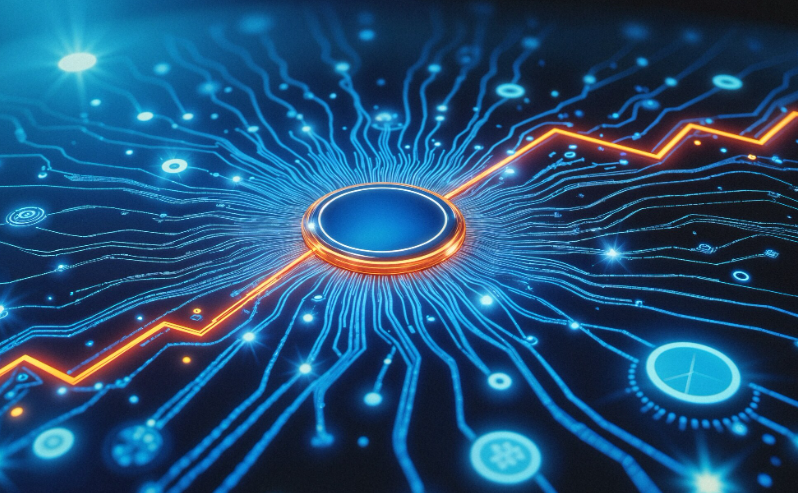
Computing technology continues to develop as the demand for faster processing, better connectivity, and lower energy use grows. Traditional electronic chips have supported decades of technological progress, but they face increasing challenges as modern workloads become more demanding.
Artificial intelligence, cloud computing, high-performance computing, and large-scale data centres all require huge amounts of data to be moved and processed quickly. Photonic chips offer a different approach by using light to transmit and process information.
Instead of relying entirely on electrical signals, photonic technology uses photons to carry data. This can provide high bandwidth and efficient data movement, making photonic chips an area of growing interest in modern computing.
Understanding Photonic Chips
Photonic chips are integrated circuits that use light alongside or instead of electrical signals for certain functions. They contain optical components that can guide, manipulate, and detect light within a very small space.
Conventional chips mainly use electrical signals to move information between components. As computing systems become faster and more complex, moving large amounts of data electrically can consume significant amounts of energy and create heat.
Photonic systems approach the problem differently. Light can carry large amounts of information through optical channels, allowing data to move quickly with potentially lower energy use for certain types of communication.
This does not mean that photonic chips completely replace electronic chips. In many practical systems, photonic and electronic components work together, with each technology handling tasks where it performs best.
How Photonic Chips Work
A photonic chip can contain components such as waveguides, lasers, modulators, and photodetectors. These components work together to control and transmit optical signals.
Waveguides direct light through the chip in a similar way that wires guide electrical signals. Modulators can change aspects of an optical signal so that information can be encoded. Photodetectors then convert optical signals back into electrical signals when required.
The process allows information to move through a system using light rather than relying solely on electrical connections.
One of the main advantages of this approach is bandwidth. Different optical wavelengths can potentially carry separate data channels, allowing large amounts of information to travel through the same physical connection.
Why Data Movement Matters
Modern computing is not only limited by how quickly a processor can perform calculations. Moving data between processors, memory, storage, and networking equipment can also become a major limitation.
This is particularly important in systems that handle artificial intelligence and other data-intensive workloads. Powerful processors may need to exchange enormous amounts of information, and the energy required for this movement can become significant.
Photonic technology can help address this challenge by providing high-speed optical connections between components.
Rather than focusing only on making processors faster, engineers can use photonics to improve the way information moves through a computing system.
High Bandwidth and Fast Communication
One of the main reasons photonic chips are attracting attention is their ability to support high-bandwidth communication.
Light operates at very high frequencies, and optical systems can carry multiple data channels using different wavelengths. This allows a single optical connection to transport substantial amounts of information.
For data centres and high-performance computing systems, this capability can be valuable. Large volumes of information need to move between servers and processing units, and traditional electrical connections can face limitations as data rates increase.
Photonic connections can provide a way to handle these growing communication requirements while keeping physical connections relatively compact.
Energy Efficiency and Heat Management
Energy use is another major consideration in modern computing. Large data centres can contain thousands of servers, each producing heat while consuming electricity.
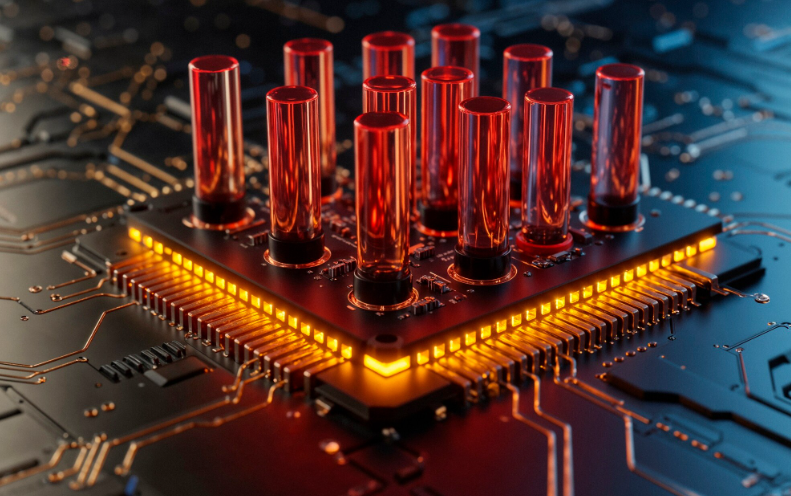
Cooling these systems requires additional energy, so reducing power consumption can have benefits beyond the chips themselves.
Photonic technology may reduce energy use for specific data communication tasks because optical signals do not experience electrical resistance in the same way as current travelling through conventional wiring.
However, photonic chips still require energy. Lasers, electronic control systems, signal conversion, and other components all consume power. The overall benefit depends on how the technology is designed and where it is used.
The most promising applications are therefore likely to involve areas where the advantages of optical communication outweigh the additional complexity.
Photonic Chips and Artificial Intelligence
Artificial intelligence is creating new demands for computing infrastructure. Training and running advanced AI models requires large amounts of processing power and data movement.
AI accelerators often work with huge datasets and need to exchange information between processing units. As systems become larger, communication between these components can become a significant part of the overall workload.
Photonic technology could support AI systems by providing faster connections between processors and other components. Researchers are also exploring photonic computing approaches that perform certain mathematical operations using optical signals.
This could open new possibilities for specialised AI hardware. Instead of using photonics for every computing task, future systems may combine optical and electronic processing to improve performance for particular workloads.
Applications in Data Centres
Data centres are one of the areas where photonic technology could have a major impact. These facilities need to transfer enormous amounts of data between servers, switches, storage systems, and processors.
As cloud services, AI platforms, streaming services, and other online applications grow, data centre networks need to handle increasing traffic.
Optical communication is already important in data centre networking, but integrating more photonic functions directly onto chips could reduce the size and power requirements of certain connections.
Photonic integrated circuits may therefore become increasingly useful as data centre operators look for ways to improve network performance and energy efficiency.
Telecommunications and Networking
The telecommunications sector is another natural application for photonics. Modern networks already depend heavily on optical fibre because it can carry large amounts of information over long distances.
Photonic chips can help process and manage optical signals in networking equipment. Their compact size makes it possible to integrate optical functions into increasingly small devices.
As demand for faster internet connections, cloud services, video communication, and connected devices continues to grow, network operators need technologies capable of handling larger volumes of data.
Integrated photonics can contribute to this development by improving the way optical signals are generated, controlled, transmitted, and received.
Combining Electronic and Photonic Technology
The future of computing is unlikely to be based entirely on photonics. Instead, electronic and photonic technologies are likely to work together.
Electronic circuits remain highly effective for many computing tasks. They are supported by mature manufacturing processes and can perform complex logic and control operations efficiently.
Photonic components, meanwhile, are particularly useful for moving large amounts of information quickly.
A hybrid system can therefore assign different tasks to different technologies. Electronics can handle computation and control, while photonics can manage high-speed data movement.
This combination could become increasingly important as computing systems grow more powerful.
Challenges in Manufacturing
Despite their potential, photonic chips face several challenges before they can become common across a wide range of computing devices.
Manufacturing optical components on a small scale requires high precision. Components need to work together reliably while fitting within extremely limited space.
Integrating photonic components with existing semiconductor manufacturing processes can also be complicated. Optical and electronic systems have different requirements, and combining them can increase manufacturing complexity.
Cost is another consideration. New manufacturing methods and specialised materials can make photonic systems more expensive than established electronic technologies.
For wider adoption, manufacturers need to improve production methods, reliability, performance, and cost at the same time.
Conclusion
Photonic chips represent an important area of development in modern computing. By using light to transmit and, in some cases, process information, they offer potential advantages in bandwidth, communication speed, and energy efficiency.
Their role could become particularly important in data centres, telecommunications, artificial intelligence, and high-performance computing, where large amounts of data need to move quickly between different parts of a system.
There are still challenges involving manufacturing, cost, materials, integration, and system design. However, continued progress in photonic integrated circuits could make optical technology an increasingly important part of future computing.
The likely direction is not a complete move from electronics to photonics. Instead, the future may involve closer cooperation between the two, combining the strengths of electronic processing with the high-speed communication capabilities of light.