By a commercial HVAC industry contributor
You hear the same complaints every week. The accounting department is freezing, while the team in the south-facing conference room is overheating. Vents are whistling in one office and dead quiet in another. You may also notice stuffy air quality or persistent odors in certain areas. These are not just comfort issues. They are signs that your HVAC system is fighting itself. An unbalanced system forces fans and other parts to run harder and longer than they should. This wastes energy and wears out expensive equipment faster.
This energy waste adds up. Commercial buildings use a lot of energy, and HVAC systems are the biggest energy users inside them. When air doesn’t flow correctly, you pay to heat and cool rooms that don’t need it, while other areas don’t get enough. Fiddling with thermostats won’t fix the root problem. The only real solution is a process called balancing commercial hvac systems. This makes sure the right amount of heated or cooled air gets to every room, just like the system was designed to do.
Quick answer: An unbalanced commercial HVAC system wastes energy, makes equipment break down sooner, and creates uncomfortable hot and cold spots. To fix it, a special process called testing, adjusting, and balancing (TAB) is used. This process matches the system’s real airflow to the original design plans.
What’s inside
· What Is HVAC Balancing, Really?
· Mistake 1: Ignoring the Original Design Intent
· Mistake 2: Chasing Symptoms Instead of Causes
· Mistake 3: Relying on Uncalibrated Instruments
· How Much Is an Unbalanced System Really Costing You?
· How Can You Verify the Work Was Done Correctly?
· Frequently Asked Questions
What Is HVAC Balancing, Really?
HVAC balancing is a methodical process. It ensures your heating and cooling system performs to its design specifications. The work is often called TAB, which stands for Testing, Adjusting, and Balancing. Each step is critical for a successful outcome.
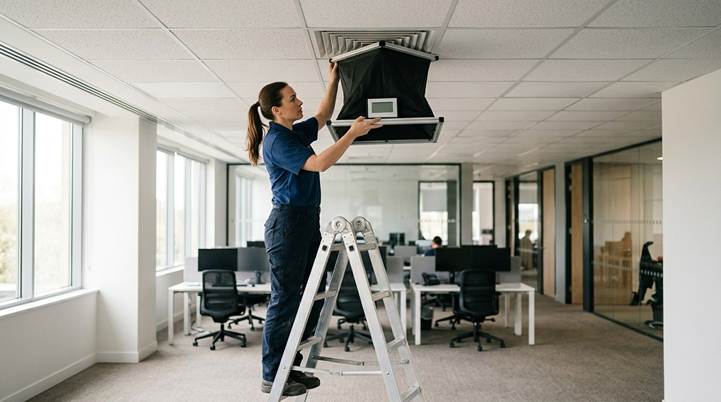
First, a certified technician tests your system. They use specialized instruments to measure airflow, temperature, and pressure. They check fan speeds and motor power draws. This creates a detailed snapshot of how your system is currently performing. It identifies exactly where problems exist.
Next, the technician makes adjustments. They might change fan speeds or adjust the positions of dampers inside the ductwork. These dampers act like valves, controlling how much air flows down each path. The goal is to correct the imbalances found during the testing phase.
Finally, the technician balances the entire system. They re-test after each adjustment to see the effect. This continues until the airflow at every single grille and diffuser matches the original engineering plans. This systematic approach ensures every room gets the right amount of conditioned air.
Mistake 1: Ignoring the Original Design Intent
Every commercial HVAC system is built from a detailed plan. Mechanical engineers create this plan, called the design intent. It specifies the exact amount of air, in cubic feet per minute (CFM), that each space requires. This calculation is based on room size, occupancy, and heat load from windows or equipment.
A common mistake is to perform adjustments without consulting these original documents. A technician might simply try to force more air into a room that feels hot. This ignores the reason the room was designed for a specific airflow in the first place. It is a guess, not a solution.
Consider an office that was recently renovated. Walls were moved and a large conference room was split into two smaller offices. If a technician tries to balance the system without knowing this, they will fail. They would be balancing the airflow for a room that no longer exists. A proper TAB process always starts with the design plans to understand how the system is supposed to work.
Mistake 2: Chasing Symptoms Instead of Causes
An unbalanced system creates obvious symptoms. You get complaints about a specific office being too cold or a hallway being too drafty. The mistake is trying to fix only that one spot. This approach almost always creates a new problem somewhere else.
For example, a manager complains their office is too stuffy. An untrained person might close the dampers in the surrounding offices. This forces more air into the manager’s office, fixing the immediate symptom. But now the other offices are getting no air, and the main duct has too much pressure.
A certified technician looks for the root cause. They would trace the ductwork leading to the stuffy office. They might discover a stuck fire damper or a section of duct that was crushed during a recent repair. Fixing that single, underlying issue solves the problem permanently. It also restores the entire system to its proper operational state without causing new issues.
❝ Insider Tip: A frequent misdiagnosis for a hot room is “inadequate airflow.” Technicians may be tempted to increase fan speed to push more air. However, the real problem could be a faulty thermostat giving a false reading, or a large, uninsulated window causing a high heat load that the system was never designed to handle.
Mistake 3: Relying on Uncalibrated Instruments
Accurate measurements are the foundation of HVAC balancing. The entire process depends on the data collected by a technician’s tools. If those tools are not accurate, the final balance will be incorrect. This is why instrument calibration is so important.
Calibration is the process of checking a tool against a known standard. It ensures the readings are true. Tools like air velocity meters and pressure gauges can drift over time. Regular calibration corrects this drift and guarantees precision. Without it, the numbers are just guesses.
Imagine a technician using an uncalibrated airflow hood. The tool might report that a diffuser is supplying 150 CFM of air. The technician sees this number and thinks the room is balanced correctly. But if the tool is off by 20%, the room is actually only getting 120 CFM. The comfort problem will persist because the work was based on bad data.
How Much Is an Unbalanced System Really Costing You?
An unbalanced system costs you money in three main ways: wasted energy, equipment that breaks down too soon, and less productive employees.
The costs show up on your power bill. Commercial buildings use a huge amount of the nation’s energy. The U.S. Energy Information Administration says they account for about 17% of the total. Inside your building, the HVAC system uses the most energy. According to the U.S. Department of Energy, heating and cooling account for around 35% of the energy used in buildings. When the system is out of balance, a lot of that money is wasted.
This waste happens because the system isn’t working smart. Air, like water, takes the easiest path. Without proper balancing, too much heated or cooled air floods into nearby rooms, while rooms farther away don’t get enough. To fix this, people often turn up the main fans to force air to the problem spots. This uses a lot more energy and makes the rest of the system too powerful, causing noise and drafts. It’s like driving your car with one foot on the gas and the other on the brake.
❝ A key idea in HVAC is that small changes in fan speed have big effects on energy use. A common rule is that slowing a fan by just 10% can cut its energy use by almost 27%. Because of this powerful link, even small adjustments made during balancing can lead to big savings on your energy bills.
The costs go beyond your monthly power bill. Running the system too hard puts a lot of stress on fan motors, bearings, and belts. This leads to more breakdowns and a shorter life for your equipment. Industry guidance, including that of the American Society of Heating, Refrigerating and Air-Conditioning Engineers (ASHRAE), treats proper balancing as a basic step toward lower HVAC energy costs. This process doesn’t just save you money on energy. It also helps you avoid paying for major repairs by making sure your equipment works the way it was designed to, not like it’s always in an emergency.
How Can You Verify the Work Was Done Correctly?
You can check if an air balance was done right by looking at the final report. This is called a Test, Adjust, and Balance (TAB) report. It should give you clear, detailed measurements for every part of your system and compare them to the original design plans.
A technician’s training is a good sign of quality work. Look for certifications from groups that set industry standards. The two main ones in the U.S. are the National Environmental Balancing Bureau (NEBB) and the Associated Air Balance Council (AABC). A certification from them means the technician and their company have passed tough tests and follow strict rules, like always using tools that have been recently checked for accuracy.
The final report is the best proof of a good job. It shouldn’t be a simple summary. It should be a detailed record of how your HVAC system is working. It will compare the original design numbers with the final airflow measured at every vent in your building. Certified firms, like those with the Associated Air Balance Council (AABC), must follow strict rules for how they measure and report this data. A good report gives you a starting point for future upkeep and a clear picture of your system’s health.
❝ Ask any company you might hire if you can see a sample of a final report (with private information removed). A company that does good work will be happy to show you. If they seem unwilling or just give you a simple summary that looks like a bill, that’s a big warning sign.
A good report should be a tool you can use, not just a file you put in a drawer. Here is what to look for versus what to avoid.
| Feature | Comprehensive Report Includes | Red Flag Report |
| Design vs. Actual | Shows the planned airflow (CFM) next to the final measured airflow for every vent. | Only lists the final numbers without comparing them to the original plan. |
| Instrument Data | Lists the tools used and shows when they were last checked for accuracy (calibrated). | Doesn’t mention tools or calibration, so you can’t be sure the numbers are correct. |
| System Conditions | Includes system details like fan pressure, motor power, and fan speed (RPMs) from before and after the work. | Is missing key system data and only shows numbers for individual vents. |
| Damper Positions | Notes the final position of all dampers inside the ducts (e.g., 45% open). | Doesn’t record damper settings, so the balance can’t be checked or restored later. |
Frequently Asked Questions
Can you balance your own commercial HVAC system?
You should not attempt to balance a commercial system yourself. The process requires specialized and expensive equipment that must be properly calibrated. Without tools like an airflow hood or a digital manometer, you are just guessing.
Professional balancing also requires a deep understanding of HVAC design principles. Technicians are trained to read mechanical blueprints and understand how the entire system works together. A wrong adjustment in one area can easily create bigger problems elsewhere. For safety and accuracy, always hire a certified TAB professional.
What is the general procedure for balancing an HVAC system?
The procedure is systematic and follows a clear order. It begins with a thorough review of the building’s mechanical plans to understand the design intent. The technician then takes initial readings of the entire system in its current state.
Next, they start at the source, the main air handler unit. They measure and adjust fan speed and motor performance. From there, they work their way down the main supply ducts, adjusting primary dampers. Finally, they move to the individual rooms, fine-tuning the airflow at each diffuser and grille until it matches the design. They re-test as they go to ensure the whole system is in harmony.
About the author
Thrivaire provides certified testing, adjusting, and balancing (TAB) for commercial HVAC systems. Their technicians help building owners and managers improve energy efficiency, enhance occupant comfort, and extend the life of their equipment. More information is available at the Thrivaire website.