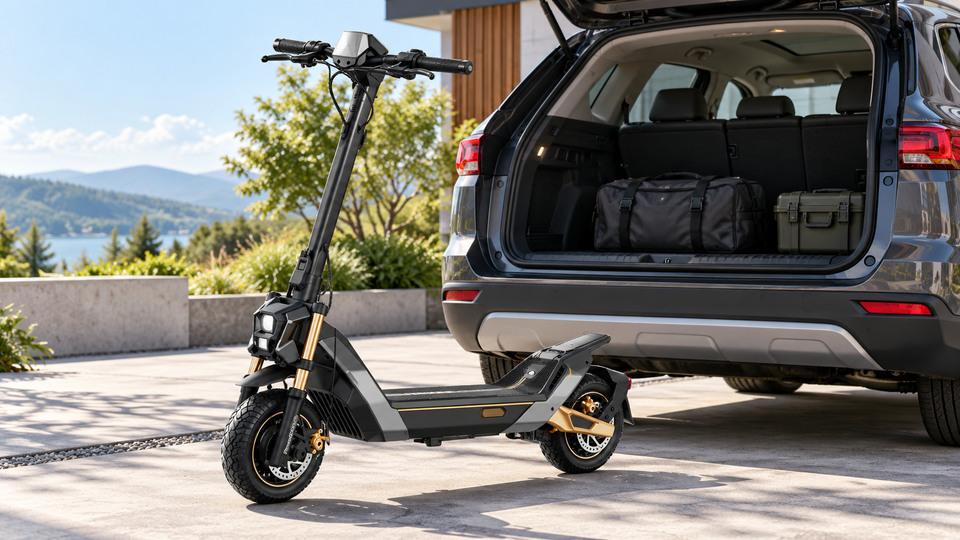
Heavy foldable electric scooters offer impressive performance, but transporting them can be challenging. Some high-performance models weigh over 70 pounds, making everyday tasks like loading a car, carrying the scooter upstairs, or taking public transportation more difficult than expected.
A folding design makes storage easier, but safe transportation still requires proper handling. Understanding your scooter's weight, using secure lifting points, and choosing the right equipment can help prevent injuries and damage.
This guide explains how to lift, carry, and transport a heavy foldable electric scooter safely in different situations.
Before Transporting Your Electric Scooter
Before moving a heavy electric scooter, check its weight, folded dimensions, and overall condition. These details help determine whether you can handle it alone or need assistance.
Check Weight and Folded Dimensions
High-performance electric scooters often have larger batteries, reinforced frames, and advanced suspension systems that add considerable weight. Even when folded, they can be difficult to lift or maneuver through tight spaces.
The following two heavy-duty models illustrate how weight and dimensions affect transportation:
|
Model |
Net Weight |
Folded Dimensions (L × W × H) |
|
NAVEE NT5 Max |
72.1 lbs |
49.2 × 24.6 × 25.4 inches |
|
NAVEE UT5 Ultra X |
90.4 lbs |
49.5 × 24.4 × 25.6 inches |
At 72.1 pounds, the NT5 Max is an example of a heavy duty electric scooter for adults that requires careful planning when lifting or carrying. Its nearly 50-inch folded length also means you'll need enough room to maneuver through doorways and into vehicle trunks.
At 90.4 pounds, the UT5 Ultra X demonstrates why transporting heavy duty electric scooters often requires additional planning. Despite having folded dimensions similar to the NT5 Max, it weighs 18.3 pounds more, making assisted lifting or a loading ramp particularly useful for vehicle transportation.
These examples highlight an important point: foldability improves storage convenience, but it doesn't necessarily make a heavy scooter easy to carry.
Before moving your scooter, consider the lifting distance, available space, and whether you can comfortably control its weight.
Fold and Secure the Scooter
Always follow the manufacturer's folding instructions rather than assuming every scooter uses the same mechanism.
Most folding electric scooters have a latch or locking system near the base of the stem, although the exact design varies by model.
Once folded, confirm that the locking mechanism is fully engaged and the stem cannot move unexpectedly. Keep your fingers away from folding joints and pinch points.
Remember that a folding lock isn't necessarily designed to support the scooter's full weight. Never use it as a carrying handle unless the manufacturer specifically approves it.
Power Off and Inspect the Scooter
Switch off the scooter before lifting or loading it to prevent accidental motor activation.
Disconnect the charger, close the charging port cover, and remove loose accessories that might fall off during transportation.
Check for damaged components, exposed cables, or anything that could interfere with lifting.
Pay particular attention to the battery. Don't transport a scooter normally if its battery shows signs of swelling, leaking, smoke, unusual heat, or a chemical odor. Follow the manufacturer's safety instructions and seek qualified assistance.
How to Lift a Heavy Electric Scooter Safely
Lifting a heavy electric scooter requires more than strength. Its long frame and uneven weight distribution can make it awkward to handle, especially in tight spaces.
Find Secure Lifting Points
Before lifting, consult the user manual for approved carrying points.
Some scooters have dedicated handles, while others may require gripping specific structural sections of the frame.
Avoid grabbing the fender, brake cables, display, or folding latch unless those parts are explicitly approved for lifting.
Weight distribution also matters. Batteries and motors can shift the scooter's center of gravity, making one end heavier than the other.
When safe to do so, test the balance with a slight, controlled lift before raising it completely.
Use Proper Lifting Techniques
The following steps can help reduce strain when lifting a scooter whose weight you can comfortably manage:
- Stand close to the scooter. Keep your feet firmly planted on stable ground.
- Bend at your hips and knees. Maintain a comfortable, neutral back position rather than bending excessively at the waist.
- Establish a secure grip. Use the manufacturer's recommended lifting points.
- Lift smoothly. Straighten your legs and hips without jerking the scooter upward.
- Keep it close to your body. Holding the scooter farther away increases strain on your back and shoulders.
- Turn with your feet. Avoid twisting your torso while carrying the weight.
When lowering the scooter, move slowly and keep your hands clear of pinch points.
Stop immediately if you lose your balance or cannot maintain a secure grip.
Know When to Ask for Help
There is no universal weight limit for safe solo lifting. Your physical capabilities, the scooter's dimensions, and the surrounding environment all affect what you can handle.
A short lift into a low car trunk may be manageable, while carrying the same scooter upstairs can be considerably more difficult.
Consider getting help when the scooter feels unstable, must be lifted above a comfortable height, or needs to pass through a narrow space.
For a two-person lift, agree on the gripping points and coordinate each movement. When the load is too heavy or awkward to control, use suitable mechanical assistance instead.
How to Transport an Electric Scooter in a Car
Transporting a heavy electric scooter by car is often practical for road trips and longer journeys. The main challenges are fitting it into the vehicle, loading it safely, and preventing movement during travel.
Check Trunk Space and Fit
Compare your scooter's folded dimensions with the available cargo space before loading.
Measure both the trunk opening and the interior. A scooter may fit inside the cargo area but still be difficult to maneuver through a narrow opening.
Allow extra clearance for protruding handlebars, wheels, and other components. Also consider the angle required to move the scooter into position.
Larger scooters may be easier to load into an SUV, hatchback, or vehicle with folding rear seats.
Measuring beforehand is the simplest way to avoid loading difficulties.
Load and Unload the Scooter Safely
Park on level ground, engage the parking brake, and clear any obstacles around the vehicle.
For manual loading:
- Fold and power off the scooter.
- Position it close to the trunk opening.
- Grip the approved lifting points securely.
- Lift with controlled movements, keeping the scooter close to your body.
- Guide it into the cargo area without striking the vehicle.
- Lower it gently into a stable position.
Avoid reaching far into the trunk while supporting the scooter's full weight.
For scooters approaching 90 pounds, a properly rated loading ramp can reduce the need for manual lifting, especially when loading into SUVs or other vehicles with higher cargo floors.
Choose a ramp with adequate load capacity, a nonslip surface, and a secure connection to the vehicle. Keep the scooter powered off and physically controlled throughout loading.
When unloading, reverse the process carefully rather than pulling the scooter over the trunk edge or allowing it to drop.
Secure the Scooter During Travel
Once loaded, the scooter must be restrained to prevent sliding or tipping during braking and turns.
Place it low in the cargo area and follow any manufacturer instructions regarding its transportation position.
Use appropriate tie-down straps with the vehicle's designated cargo anchor points. Attach the straps only to suitable structural points on the scooter, avoiding delicate components and cables.
Protective padding can help prevent scratches, but it cannot replace proper restraint.
Before driving, confirm that the scooter is stable, the straps are secure, and nothing interferes with passengers or vehicle controls.
Avoid prolonged exposure to excessive heat, particularly inside a parked vehicle. High temperatures can damage lithium-ion batteries and other electronic components.
How to Carry a Heavy Electric Scooter Upstairs
Stairs are among the most challenging places to transport a heavy scooter. Limited space, changes in elevation, and reduced visibility can make even a short climb difficult.
Safe Carrying Techniques for Stairs
Assess the staircase before attempting to carry the scooter.
Make sure the steps are dry, well-lit, and free from obstacles. Confirm that you have enough room to move without striking the walls or railings.
If you can comfortably manage the scooter's weight, keep it close to your body and move slowly, one step at a time.
Always maintain a clear view of the stairs. Don't attempt to carry a scooter that blocks your view of your footing.
For heavier models, a coordinated two-person lift may help distribute the load, provided the staircase offers enough room for both people to move safely.
Never drag the scooter by its handlebars or bounce it up and down the steps. These methods can damage components and increase the risk of losing control.
Alternatives to Carrying the Scooter
An elevator is usually the safest and most convenient option when moving a heavy scooter between floors.
Other alternatives include ground-floor storage or a suitable accessible route that avoids lifting.
On level surfaces, rolling the scooter is generally easier than carrying its full weight.
If you regularly need to transport a scooter upstairs, consider its weight before purchasing. Even a well-designed folding scooter may be impractical for frequent stair carrying.
How to Transport an Electric Scooter on Public Transit
Combining an electric scooter with buses or trains can be convenient, but heavy models present additional challenges in crowded stations and vehicles.
Check Bus and Train Rules
Public transportation policies differ by transit operator. Some allow privately owned folding electric scooters, while others impose restrictions related to size, weight, or onboard storage.
Always check the current rules for your local transit system before traveling.
Even when a scooter is permitted onboard, consider whether its weight makes it practical to carry through stations or onto the vehicle.
Keep the Folded Scooter Secure
Keep your scooter folded and under control throughout the journey, as required by the transit operator.
Follow the operator's storage instructions, and avoid blocking doors, aisles, emergency exits, or accessible spaces.
Position the scooter so it cannot roll or slide when the vehicle accelerates or brakes.
If the vehicle is too crowded to accommodate it safely, consider a less busy service.
Helpful Accessories for Transporting Heavy Scooters
The right equipment can reduce manual lifting and improve stability during transportation.
Three accessories are particularly useful:
- Heavy-duty carrying straps: May improve grip and weight distribution when attached to manufacturer-approved points. Check the strap's rated capacity and suitability before use.
- Loading ramps: Help move heavy scooters into elevated cargo areas without lifting their entire weight. Choose a ramp rated for the load and compatible with the vehicle's loading height.
- Tie-down straps and protective padding: Keep scooters stable during vehicle transportation and reduce the risk of contact damage. Use straps with appropriate working load ratings and secure them to approved attachment points.
Accessories should complement safe handling techniques, not compensate for an unmanageable load.
FAQs About Transporting Heavy Electric Scooters
Can One Person Lift a Heavy Electric Scooter?
Yes, but it depends on the scooter's weight, dimensions, balance, and the person's physical capabilities. Scooters weighing 70 pounds or more may be difficult to lift safely without assistance. Use a second person or suitable loading equipment if you cannot maintain a secure grip and controlled posture.
Can You Lay an Electric Scooter on Its Side?
Some electric scooters can be transported on their side, but always check the manufacturer's instructions first. If permitted, protect the display, handlebars, brake components, and other vulnerable parts from pressure or impact. Secure the scooter against movement and follow any battery handling requirements.
Can a Foldable Electric Scooter Fit in a Car Trunk?
Many foldable electric scooters fit in car trunks, but compatibility depends on the folded dimensions and available cargo space. Measure both the trunk opening and interior before loading. Larger models may fit more easily in SUVs, hatchbacks, or vehicles with folding rear seats.
What Is the Easiest Way to Move a Heavy Electric Scooter?
Rolling the scooter on level ground is generally the easiest option. For vehicle loading, a suitable ramp can reduce manual lifting. When moving between floors, an elevator is usually preferable to carrying the scooter upstairs.
Can You Take a Heavy Electric Scooter on a Bus or Train?
It depends on the transit operator's rules. Some systems allow privately owned folding electric scooters, while others restrict their size, weight, or storage. Check the applicable policies before traveling and make sure you can handle the scooter safely throughout the trip.