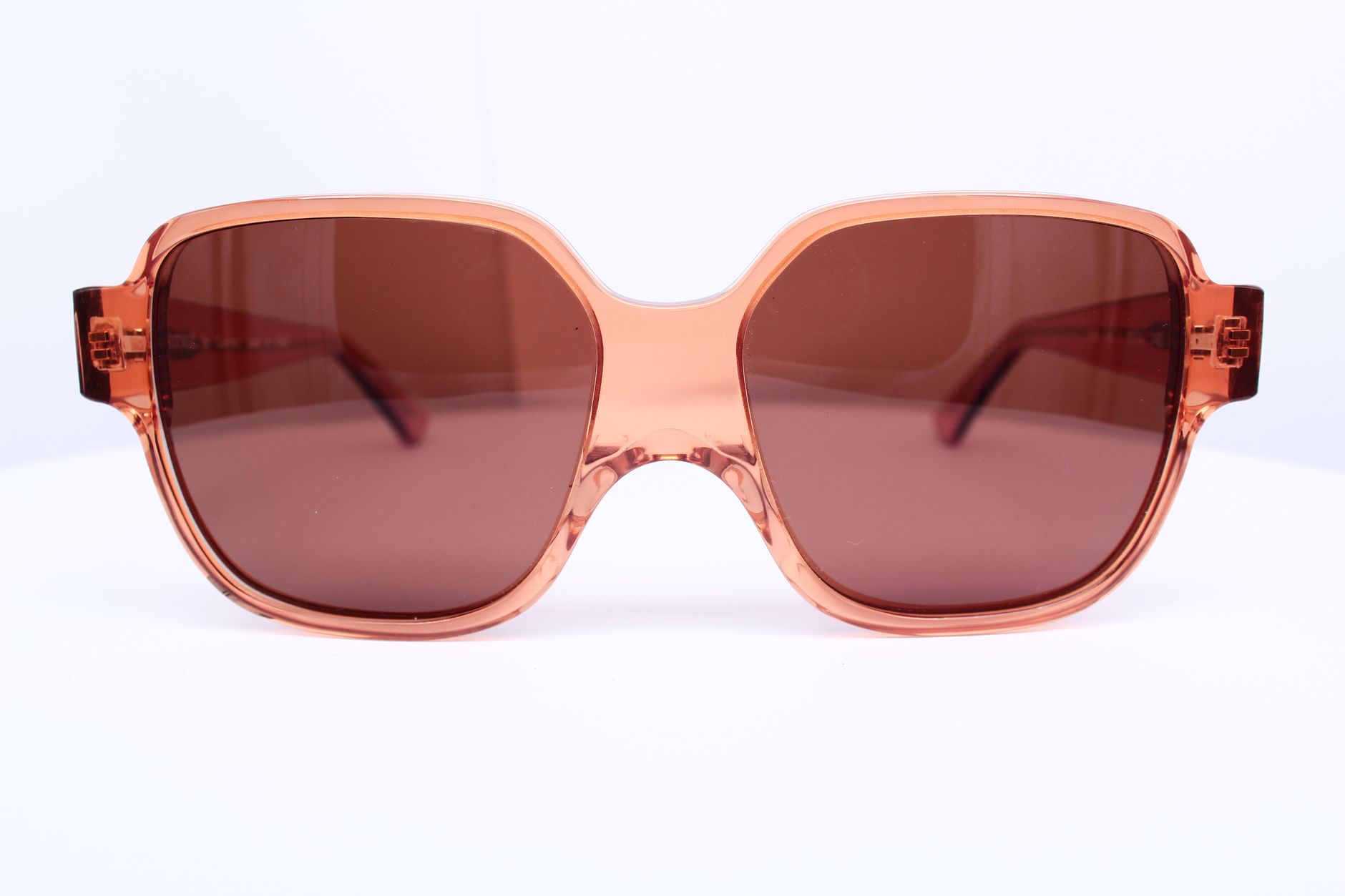
Most people pick up a pair of pink or amber sunglasses in a shop, smile at the mirror and put them back. The tint feels like a statement they’re not sure they can carry off. In practice, a coloured lens usually does the opposite of what people fear, softening a look rather than shouting over it.
This guide covers:
• Why tinted lenses seem harder to wear than they are
• How to match a tint to your wardrobe and skin tone
• What the colour of a lens can’t tell you
• How to ease into brighter tints
Why Tinted Lenses Seem Harder to Wear Than They Are
The hesitation usually comes from the frame, not the lens. A bright frame changes your whole face, while a tinted lens sits back and warms everything slightly, much like a filter on a photo. Rose and amber tints in particular sit close to natural skin tones, so they tend to look softer in person than on a display stand. Trying a pair on outdoors, in daylight, gives a far truer picture than a shop mirror.
Pink has become the easy entry point for exactly that reason. Quay’s pink lens range, for instance, mixes gradient and mirror finishes across several frame shapes. Seen on a street in July, it’s not hard to believe that pink sunglasses from Quay are quietly becoming a summer staple.
Matching a Tint to Your Wardrobe and Skin Tone
A good rule is to treat the tint as a neutral and let it pick up one colour you already wear. Warm tints suit earthy palettes, while cooler ones sit well with greys, navy and black. Skin tone matters less than people think, because the lens covers so little of the face. What counts is whether the tint clashes with the clothes you reach for most.
| Tint | Effect | Pairs well with |
| Rose or pink | Warms the view, softens the look | Denim, white, beige, pastels |
| Amber or brown | Adds warmth and contrast | Camel, olive, rust, black |
| Blue | Cool and crisp | Navy, grey, white |
| Green | Calm, slightly vintage | Khaki, cream, brown |
Frame shape is the other half of the equation. Picking a tint in a shape you already know suits you takes most of the risk away, and Quay’s sunglasses span aviator, cat-eye, square and shield styles, which makes that kind of like-for-like swap straightforward.
What the Colour of a Lens Can’t Tell You
A pretty tint and a protective lens are two separate things. According to the American Academy of Ophthalmology, the darkness of a lens isn’t an indication of protection, and buyers should look for a label stating 100 percent UV blocking or UV400. Cheaper pairs with that label can protect just as well as expensive ones.
Lens category matters too. Under Australia’s mandatory sunglasses standard, category 0 and 1 lenses count as fashion spectacles, and category 1 lenses aren’t suitable for driving at night. Category 4 lenses aren’t suitable for driving at all, so it’s worth checking the label before a pair becomes your everyday driving glasses.
Easing Into Brighter Tints
Gradient lenses, darker at the top and lighter at the bottom, are the gentlest place to start. Wear a new tint on a weekend first, with plain clothes, and the novelty usually wears off within a day. Pairing the tint with a frame in black or tortoiseshell also keeps the look grounded. After that, a second, bolder colour feels like a small step.
Making Colour Part of Your Everyday Rotation
Colour-tinted lenses ask far less of an outfit than they appear to. Choose a tint that works as a neutral with your wardrobe, put it in a frame shape you trust, and confirm the UV label before you buy. Starting with a gradient or a pale rose takes most of the nerves out of the first pair.
A coloured lens is one of the easiest ways to refresh a look without changing anything else, and it rarely needs a new wardrobe to go with it. One good pair is usually enough to start.
Frequently Asked Questions
Are pink-tinted sunglasses good for driving?
It depends on the lens category rather than the colour. Under Australia’s standard, category 1 lenses aren’t suitable for night driving and category 4 lenses aren’t suitable for driving at all. Category 2 and 3 lenses are general-purpose sunglasses, and polarised versions help cut road glare. Check the label before driving in a new pair.
Do coloured lenses protect your eyes as well as dark ones?
They can. The American Academy of Ophthalmology notes that lens darkness doesn’t indicate UV protection. A light pink or amber lens labelled 100 percent UV blocking or UV400 protects just as well as a very dark one. Polarisation is a separate feature: it cuts glare but doesn’t add UV protection on its own.
What lens colour is best for everyday wear?
Grey is the usual all-rounder because it dims light without changing colours much. Brown and amber add contrast on cloudy days, while rose and pink warm the view. Any of them works daily if the lens carries proper UV protection. Lighter tints suit overcast days, while darker ones are better in strong sun.