- Why One Fragrance Can Smell So Different
- What Happens After Perfume Is Sprayed
- Key Factors That Shape Fragrance Wear
- Paper Strips Versus Skin Tests
- A Simple Fragrance Testing Method
- Longevity, Projection, and Sillage
- Common Fragrance Testing Mistakes
- Fragrance and Sensitive Skin
- Final Takeaway
A fragrance can smell crisp and citrusy on a test strip, soft and warm on one person, and unexpectedly sharp or sweet on another. That does not mean the perfume has changed. It means the scent experience develops after spraying, as the formula interacts with skin, air, fabric, temperature, and your own sense of smell.
Learning a little about skin chemistry and fragrance can make perfume shopping far less confusing. Instead of judging a scent in the first few seconds, give it enough time to move from its opening to its dry-down. The result is a more reliable sense of whether you will enjoy wearing it.
Why One Fragrance Can Smell So Different
Listed notes are useful clues, but they are not a guarantee of exactly what you will smell all day. A perfume described as bergamot, rose, cedar, and musk may begin with sparkling citrus notes, become floral after a while, and eventually sit close to the skin with a smooth, woody character. Each stage can feel noticeably different.
Your surroundings also matter. Warm air may make a scent seem more present, while cool air can make it feel quieter. A strongly scented body wash, hair product, or lotion can overlap with perfume and change the overall impression. Even attention matters: a scent you notice clearly at first may seem to disappear simply because your nose has adapted to it.
What Happens After Perfume Is Sprayed
Perfume is a mixture of aromatic materials carried in a base, often alcohol. After application, those materials do not all evaporate at the same pace. Many lighter, more volatile materials are noticeable early, while other materials tend to become clearer later. This is why fragrance descriptions often use the familiar categories of top, heart, and base notes.
Skin is not a neutral surface like blotter paper. It has natural oils, moisture, warmth, and whatever products you applied before the fragrance. These conditions can influence how quickly a scent seems to unfold and how it feels during wear. The change is usually subtle, but it is enough to make a skin test more useful than a strip alone when choosing a bottle.
Key Factors That Shape Fragrance Wear
Skin Moisture
Very dry skin can make a fragrance feel less rounded or seem to fade sooner. If you want a more consistent test, apply an unscented moisturizer first and let it absorb before spraying. This reduces competition from fragranced skincare and gives you a similar starting point each time you test.
Body Warmth and Environment
Areas with more warmth can make scent easier to notice, especially soon after application. However, stronger early presence is not the same as better longevity. A fragrance may project brightly for an hour and then soften, while another stays close to the skin for much longer.
Personal Scent and Routine
Natural body scent, soap, deodorant, exercise, humidity, and clothing can all affect your perception of perfume. For the clearest comparison, test fragrances on days when your routine is similar. That makes it easier to decide whether a difference comes from the perfume itself or from the conditions around it.
Formula and Concentration
Colognes, eau de toilette, eau de parfum, perfume oils, and solid fragrances can wear differently. Concentration labels can offer a general idea of a product’s style. Still, they do not reliably predict exact hours of wear: the specific formula, the materials used, and the amount applied all matter.
Paper Strips Versus Skin Tests
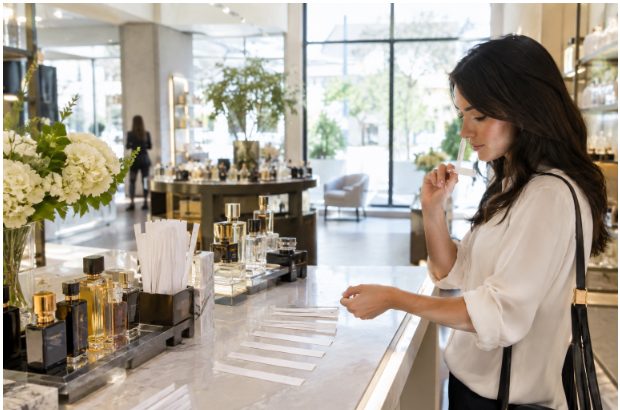
A paper strip is excellent for narrowing a large selection. It can show the fragrance’s general direction and help you compare openings without covering yourself in several scents. It is especially helpful when deciding whether a perfume is floral, fresh, spicy, woody, sweet, or clean enough to explore further.
What it cannot fully show is the complete wearing experience. Paper does not reproduce the warmth and changing conditions of skin, and it cannot tell you whether a scent feels comfortable after several hours. Use strips for initial comparison, then choose only one or two favorites for skin testing. Limiting the number helps reduce nose fatigue.
A Simple Fragrance Testing Method
- Begin with clean skin and avoid strongly scented lotion or body products.
- Spray each candidate on a separate paper strip and label it.
- Choose one or two fragrances that still appeal after a few minutes.
- Apply a small amount to separate areas of skin, such as opposite forearms.
- Do not rub your wrists together, since that can disturb the wet application and blur your comparison.
- Revisit each scent after about 20 to 30 minutes, then again later in the day.
- Write down your impressions rather than relying on memory.
A simple testing log can include these prompts:
- Opening: What stands out in the first few minutes?
- Mid-wear: What does it smell like after 30 to 60 minutes?
- Late wear: What remains after several hours?
- Projection: Does it stay close, or is it easy to notice at arm’s length?
- Comfort: Does it still feel pleasant and appropriate for your day?
- Overall preference: Would you want to wear it again?
Longevity, Projection, and Sillage
Longevity refers to how long you can detect a fragrance. Projection describes how far it seems to travel from the wearer shortly after application. Sillage is the scent trail a person may leave as they move. These terms are related, but they are not interchangeable. A perfume can last all day while staying very close to the skin.
Woody, resinous, musky, and amber-like accords are often used to create a longer-lasting impression, while bright citrus and airy aromatic effects may be most noticeable near the beginning. Clothing can hold fragrance longer than skin, but fabric can also alter the result and may be marked by some products. Treat it as a supplement to skin testing, not a replacement.
Common Fragrance Testing Mistakes
- Buying after smelling only the cap or the first spray.
- Testing too many perfumes during one store visit.
- Using scented body products that compete with the fragrance.
- Assuming a perfume will smell the same on every wearer.
- Deciding it has vanished when your nose may have adapted to it.
- Judging performance only by projection rather than comfort and lasting appeal.
Fragrance and Sensitive Skin
Enjoying a scent and tolerating it on skin are separate questions. Fragrance ingredients can cause irritation or allergic reactions in some people, so read the label, follow the product directions, and stop using the product if you develop burning, itching, redness, a rash, or swelling. Possible allergic reactions to cosmetic ingredients are also a reason to seek medical advice if symptoms recur or are severe.
How to Track a Scent Over One Day
- Morning: Record the first impression shortly after spraying.
- Late morning: Note whether the scent has become fresher, warmer, sweeter, softer, or woodier.
- Afternoon: Check whether you can still notice it and whether it remains comfortable.
- Evening: Describe the dry-down and decide if the full journey suited you.
Final Takeaway
The best perfume test is personal, patient, and repeatable. Paper strips are useful for identifying promising options, but time on skin reveals a fragrance's fuller character. Give a scent space to develop, compare it under ordinary conditions, and choose the one that feels good from the opening spray to the final dry-down.