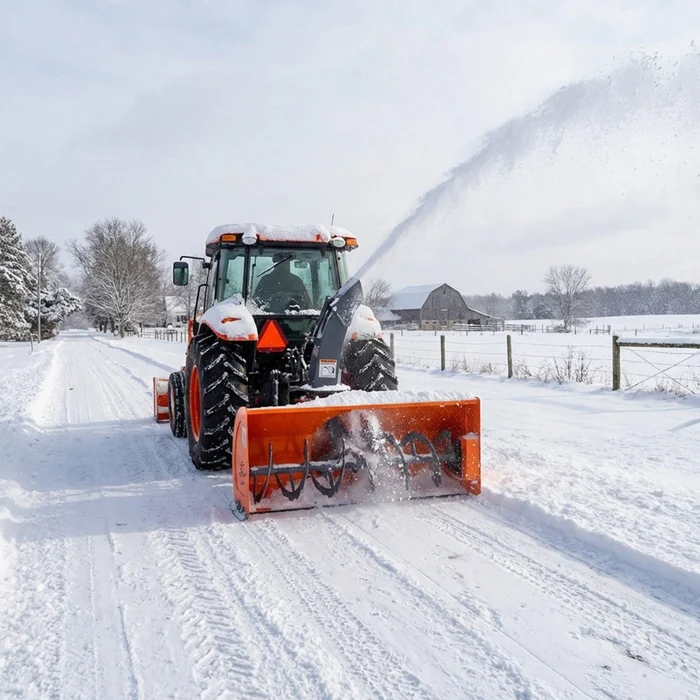
When snow arrives, a compact tractor already sitting in the barn becomes the most useful snow machine on the property, provided it has the right attachment. A 3-point hitch snow blower mounts on the back of the tractor and uses the tractor’s engine to clear driveways, farm lanes, and yards far faster than a shovel or a walk-behind unit. Choosing and using one well depends on three matches: the blower to the tractor, the hitch to the frame, and the technique to the snow.
How the Power Reaches the Blower
A tractor sends engine power to an attachment through the power take-off, a rotating shaft at the back often called the PTO. A driveshaft carries that rotation to a gearbox on the blower, which turns it ninety degrees to drive the auger and impeller. The auger is a steel screw that breaks up and gathers snow, and the impeller is a fast fan that throws it out of the chute. A tractor snow blower therefore works as a two-stage machine, with the tractor doing the work that a small engine does on a walk-behind unit.
Matching Horsepower and Weight
A blower needs enough engine power to turn the auger through packed snow, and the tractor needs enough weight to stay stable with the blower hanging behind. A manufacturer lists a range of tractor power for each model, and staying inside that range matters. A snow blower for compact tractor use that is too large will stall the engine in heavy snow, while one that is too small wastes the tractor’s strength. Front-end loader weight or ballast on the front helps balance a heavy rear attachment.
Understanding the Hitch
A three-point hitch has two lower arms and one upper link that hold an attachment in a triangle. Hitch sizes are divided into categories, with smaller tractors using Category 1 and larger ones using Category 2, and the blower must match. A quick hitch speeds up mounting by letting the tractor back up to the attachment and lock in. Check that the pins are secure and the top link is adjusted so the blower sits level.
Driving in Reverse
Most rear-mounted blowers throw snow while the tractor backs up, so the operator works looking over a shoulder. That feels awkward at first but gives the blower a clear path while the tractor’s weight rides over the cleared surface. A seat that swivels, a mirror, and a well-lit cab help, and a slow, steady pace gives time to watch for obstacles behind.
Controlling the Chute
The chute turns to aim the snow, and many models use a crank or an electric or hydraulic control. The rule is to throw with the wind or across it, and away from buildings, vehicles, and neighbors. A deflector at the top of the chute changes how far the snow flies. In wet snow, a lower deflector angle keeps the stream from clogging.
Choosing the Blower Width
A wider blower clears more per pass but needs more tractor power and more room to turn. A snow blower for compact tractor use is often sized a little wider than the tractor so the tires follow in the cleared path. Narrow lanes, tight gates, and short driveways favor a narrower unit, while a long farm lane favors a wide one.
Reading the Snow
Dry powder moves easily and can be thrown a long way, while wet, heavy snow packs and clogs the chute. Take deep drifts in layers, shaving the top first, and keep the engine speed steady so the impeller stays at full speed. Frozen ruts and plow ridges are harder, and a slower pace gives the auger time to break them up. If the machine bogs down, stop, raise the blower, and clear the blockage before continuing.
Traction and Surfaces
A tractor that spins its wheels in snow cannot push a blower effectively. Tire chains or filled tires improve grip on ice, while turf tires may need chains on packed snow. On gravel, set the blower’s skid shoes a little high so the housing does not pick up stones. Drive slowly near edges and drops, because snow hides ditches and culverts.
Safety Around a Power Take-Off
Rules that apply every time:
• Keep all shields and guards in place
• Disengage the power take-off before leaving the seat
• Never clear a clog while the tractor runs
• Keep bystanders well away from the chute
Storing the Blower Between Storms
Check the gearbox oil and grease the fittings regularly, and carry spare shear bolts, the small deliberately weak fasteners that break to protect the gearbox if the auger strikes something hard. Rinse off salt, repaint bare steel, and store the blower on blocks or a stand so it is ready for the first storm. Owners who keep the tractor and its attachments ready for winter often look at the wider range of industrial equipment for property work, so the whole fleet is prepared together.