
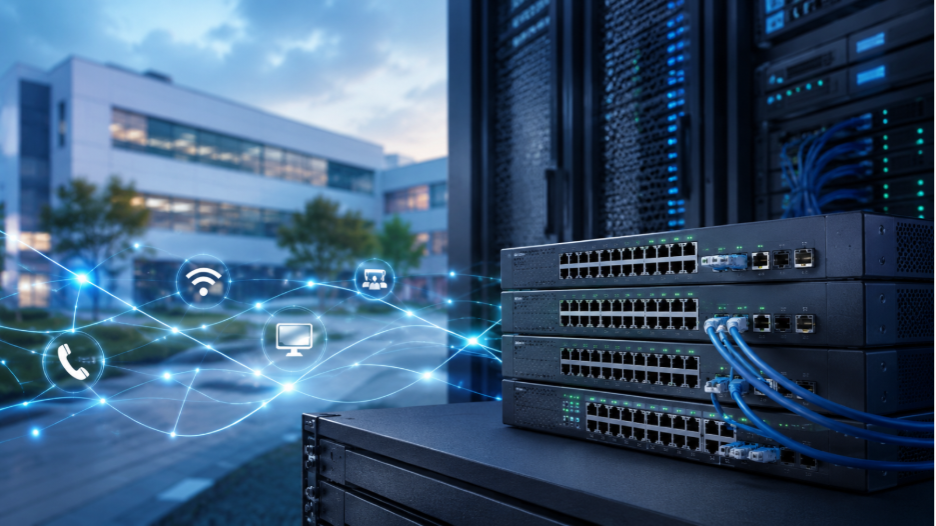
As your business expands, so does the list of devices, applications, and users who use your network.
Nevertheless, an old or poorly planned network may cause poor performance, loss of connections, and security issues that impact daily activities.
Meanwhile, controlling growing traffic and planning future growth becomes more difficult without the appropriate infrastructure.
This is where Campus switches become essential. They provide reliable connectivity, optimize traffic flow, and strengthen network security, creating a stable foundation for business operations. Consequently, organizations are able to meet the prevailing needs without impeding future developments.
This article describes the purpose of campus switches in network infrastructures and how they enhance connectivity, performance, security, and scale to support contemporary organizations.
1. Create Reliable Foundation for Enterprise Connectivity
A properly developed network starts with reliable campus switches that link users, endpoints, and applications throughout an organization. These switches cleverly direct the data to its destination instead of allowing traffic to move inefficiently, thus assisting in keeping the communication stable all over the network.
Consequently, employees are able to use business applications, shared resources, and cloud services with minimal disruptions.
In addition, campus switches serve as the hub that links desktops, laptops, wireless access points, IP phones, printers, and surveillance cameras. They facilitate consistency in network performance despite the traffic congestion during peak work periods by effectively controlling communication between these devices.
Managed solutions also offer more visibility into network activity, which enables IT teams to detect possible problems before they impact productivity.
In addition, organizations have the option of selecting either Layer 2 or Layer 3 switches based on their routing needs, so that the infrastructure meets the operational demands.
Several current campus switches can support many port densities and high-speed uplinks, enabling businesses to create a network that can handle both current workloads and future demands without requiring significant changes in infrastructure.
2. Improve Network Performance Through Efficient Traffic Management

With cloud platforms, collaboration tools, and bandwidth-heavy applications being implemented by businesses, network traffic is growing. In the absence of effective traffic control, congestion may diminish the responsiveness of applications and cause delays that affect day-to-day operations.
Campus switches can address this dilemma by routing data along optimal routes, minimizing redundant traffic and enhancing the efficiency of the whole network. As a result, applications can enjoy the bandwidth required without disruption of important business processes.
Moreover, the Layer 3 switching feature allows routing between the network segments faster, and it also lowers the latency to users who need to access resources in other departments or locations. This is even more useful in organizations that have more than one team using the same infrastructure.
The data transfer between access and aggregation layers is further enhanced by high-speed uplink options, such as 10G SFP+ and some 25G interfaces. Consequently, organizations are able to sustain an increasing amount of traffic without forming bottlenecks that curtail performance.
In the meantime, smart bandwidth control enables administrators to give business-critical applications priority over less important traffic.
Such a balanced solution assists in ensuring a stable user experience and efficient usage of the available network resources.
3. Strengthen Network Security While Simplifying Management
Firewalls and endpoint protection are not the only types of network security. Switching infrastructure is also significant in regulating access and safeguarding business-sensitive information.
Managed campus switches give more control to administrators over the devices connected to them, including advanced authentication, authorization, and policy enforcement capabilities. Consequently, organizations are in a better position to control who and what accesses the network.
MACsec encryption is also supported by some enterprise models to provide an extra security layer to data traversing network links. This assists in the minimization of the possibility of unauthorized interception, especially in settings where sensitive information is regularly exchanged.
Meanwhile, centralized management makes the daily administration easier. Instead of setting up each device separately, it allows IT teams to monitor network performance, implement configuration changes, and debug problems more effectively.
This makes maintenance less time-consuming and minimizes the chances of configuration errors.
Most enterprise switches also feature dedicated management interfaces, including USB, console, and out-of-band management ports. These characteristics simplify the process of troubleshooting and also enable administrators to have dependable access when the main network is malfunctioning.
4. Support Scalable Networks Ready for Future Growth

Technology requirements rarely remain static. Businesses continue adding employees, deploying connected devices, expanding wireless coverage, and adopting new digital services. Therefore, network infrastructure must be flexible enough to support future demands without requiring complete replacement.
Campus switches provide that scalability through a wide range of port configurations, PoE capabilities, and high-performance uplinks. Organizations can start with solutions that meet current requirements while retaining the flexibility to expand as operations grow.
Power over Ethernet (PoE+ and PoE++) support also simplifies deployments by delivering both power and data through a single Ethernet cable. This reduces installation complexity for wireless access points, IP phones, and security cameras while minimizing cable requirements.
Furthermore, businesses can select models with redundant power supply options to improve network availability in mission-critical environments. Combined with enterprise-grade hardware and modern network operating systems, these capabilities contribute to greater reliability over the long term.
Ultimately, investing in scalable switching infrastructure helps organizations accommodate changing business needs without repeatedly redesigning their networks.
This approach protects infrastructure investments while supporting consistent performance as technology evolves.
Conclusion
Campus switches form the backbone of modern network infrastructure by connecting devices, managing traffic, strengthening security, and supporting future growth. Beyond simply forwarding data, they enable organizations to build reliable, efficient, and scalable networks capable of supporting today's digital workloads.
As businesses continue expanding their use of cloud applications, connected devices, and high-speed communications, selecting the right switching infrastructure becomes increasingly important.
By investing in managed campus switches with the appropriate features and performance capabilities, organizations can create a network that delivers dependable connectivity while remaining prepared for tomorrow's operational demands.