Australians are still heading outdoors in huge numbers, but the way they travel is changing. As shorter, value-conscious camping trips gain ground, Australian brand Ozzi Gear is betting that one of the most useful upgrades is also one of the simplest: making the camping chair smaller.
Australia’s camping market is having a strong 2026. In the year ending March, Australians took 17.7 million overnight caravan and camping trips, generating 59.5 million visitor nights and $13.1 billion in expenditure. During the first quarter of 2026 alone, the number of trips increased 9% compared with the same period a year earlier, while spending rose 15%.
But another shift is taking place alongside that demand. Industry research suggests travelers are increasingly looking for value and taking shorter, closer-to-home holidays. In 2025, the average caravan and camping trip lasted around 3.4 nights, while 87% of trips took place in regional Australia.
That changing travel pattern creates an interesting opportunity for outdoor brands. If a trip is quicker, more spontaneous, and closer to home, equipment that is easy to pack, carry, and use becomes increasingly relevant.
Australian outdoor brand Ozzi Gear has built much of its business around that idea.
Rather than reinventing what a camping chair does, Ozzi Gear is trying to rethink how much space one should take up.
The Humble Camping Chair Has a Space Problem
Traditional camping chairs are hardly complicated products. Fold them open, sit down, fold them closed. The inconvenience usually becomes apparent before anyone reaches the campsite.
A family packing a car for the weekend may already be finding room for tents, bedding, food, clothing, cooking equipment, and children’s gear. Fishing adds rods and tackle. Caravan travellers have limited storage compartments. Parents heading to weekend sport may need chairs alongside bags, balls, drinks, and everything else required for the day.
The chair can quickly become one of those strangely bulky items that is easy to overlook until the vehicle is almost full.
That is the problem Ozzi Gear founder Peter Rossouw says prompted the development of the brand’s compact seating. On the company’s website, Rossouw describes becoming frustrated with carrying bulky outdoor chairs and experimenting with prototypes designed to be lighter, smaller and comfortable enough for regular use.
Ozzi Gear later formalised as OZZI GEAR GROUP PTY LTD. Australian Business Register records show the company’s ABN became active on 1 February 2024, with the OZZI GEAR business name registered the following day.
Its product range remains centred on portable outdoor seating rather than trying to become an all-purpose camping retailer. And that focus makes sense in the current market.
Why Compact Gear Matters More in 2026
Australia now has a substantial caravan and recreational vehicle ecosystem.
There were 936,755 registered recreational vehicles in Australia as of January 2025, up 4% from the previous year. Meanwhile, the caravan and camping industry contributes an estimated $27.1 billion to the Australian economy annually when visitor expenditure, caravan parks, manufacturing, and trade are considered together.
Those figures help explain why small improvements to packing efficiency can have a sizeable audience.
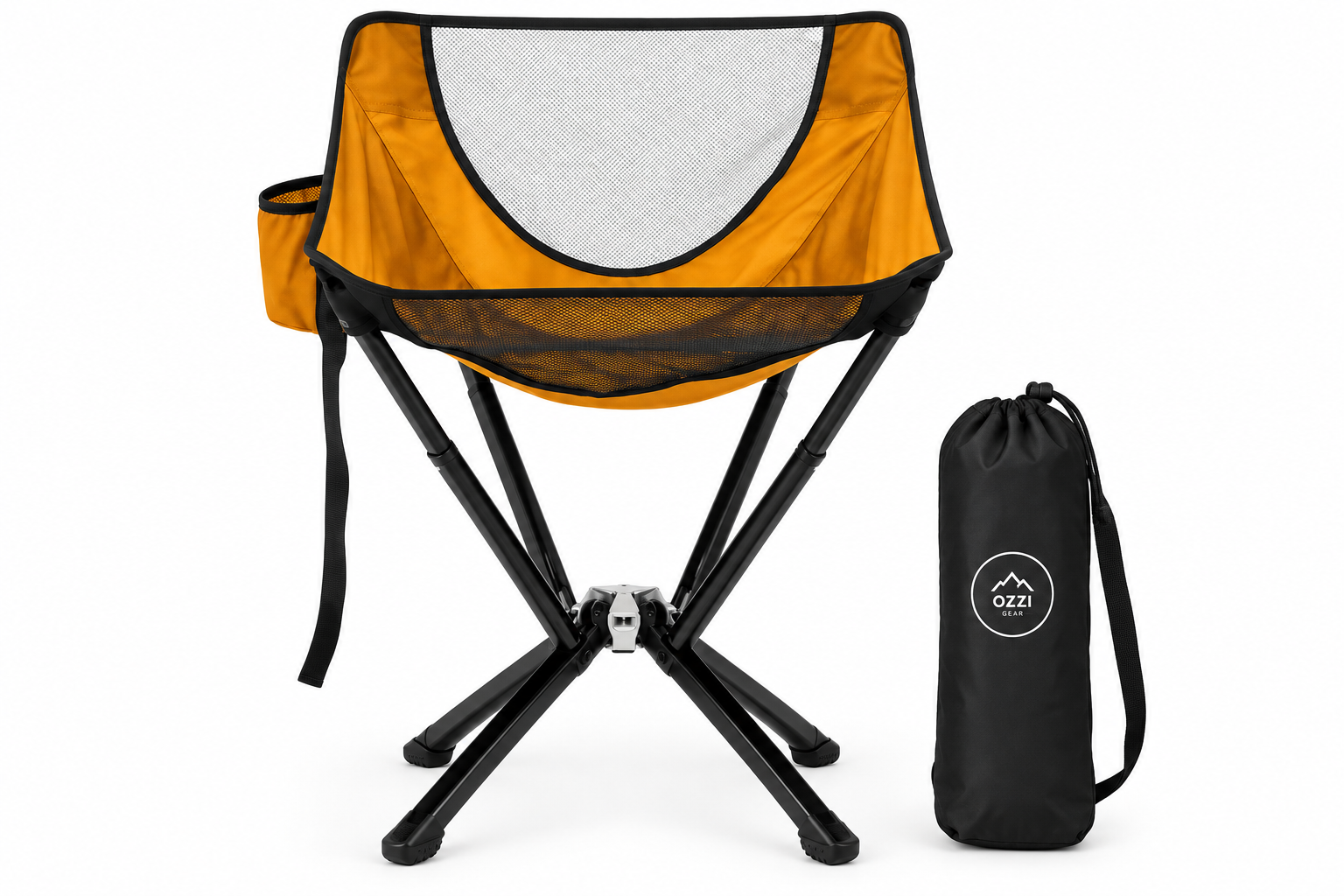
Ozzi Gear’s answer is the Ozzi Outdoor Chair, which takes the basic function of a folding camping chair and reduces its packed footprint considerably.
According to the company’s current specifications, the chair weighs 1.7 kg, folds to approximately 35 cm and is rated to support up to 150 kg. Its aluminum alloy frame and fabric seat remain connected when packed, so users don’t have a separate collection of poles and components to assemble. Ozzi Gear lists setup time at around 10 seconds.
None of those features fundamentally changes outdoor seating.
Together, however, they address a more contemporary question: how much space should a relatively simple piece of equipment be allowed to occupy?
For people travelling in a packed car, storing equipment in a caravan, or carrying their seat any significant distance, the answer increasingly appears to be “not very much.”
Ozzi Gear’s Design Is About Compromise, Not Ultralight Minimalism
There are already extremely light stools and compact hiking chairs on the market. There are also large reclining camp chairs designed primarily around comfort.
At 1.7 kg, its Outdoor Chair isn’t trying to be the lightest seat possible. Instead, the design attempts to retain the conveniences people expect from a conventional outdoor chair while reducing its packed size.
The chair includes a padded seat, cup holder and side storage pocket, while the frame is made from what the company describes as aviation-grade aluminum alloy. Its published load rating is 150 kg. The company says it conducts internal testing beyond that figure, although 150 kg remains the stated capacity for normal use.
The Real Test Is What Happens After Repeated Use
Portability is easy to demonstrate. Durability is harder. A chair can fold impressively small on day one and still prove disappointing after repeated exposure to dirt, sand, damp conditions, and the general punishment outdoor equipment receives.
Ozzi Gear appears conscious of that tension. The company says its product has undergone repeated development and real-world testing, while its current main product page advertises a lifetime warranty alongside a 45-day return period.
That warranty positioning is relevant because compact seating places considerable demands on hinges, joints, and telescoping components. A design that saves storage space is only genuinely useful if repeated folding and unfolding doesn’t become its weakness.
Consumers should still judge warranty coverage by the published terms that apply when they buy. Warranty wording can change, and coverage isn’t the same thing as a guarantee against ordinary wear, misuse or every form of cosmetic deterioration.
More broadly, Ozzi Gear’s emphasis on long-term ownership reflects another issue in outdoor equipment: cheap products aren’t necessarily inexpensive if they need to be replaced repeatedly.
That doesn’t automatically make a more expensive chair better value. It does make durability a more meaningful part of the comparison than the initial price tag alone.
A Camping Chair Designed for a Different Kind of Camping Market
Perhaps the most interesting thing about Ozzi Gear is that its central idea isn’t particularly radical. It hasn’t invented a new outdoor activity or attempted to persuade consumers they need another complicated piece of equipment. Instead, it has focused on friction.
How difficult is the chair to carry? How much room does it consume? How many pieces need to be assembled? How quickly can it be put away? And can the same product be useful beyond a campsite?
Those questions become more relevant as Australian outdoor travel evolves.
Travellers aged 30 to 54 accounted for 42% of domestic caravan and camping trips in the year ending March 2026. People aged 55 and over accounted for another 34%, as well as 41% of visitor nights.
This isn’t a market consisting solely of hikers trying to shave every possible gram from a backpack. It includes families, retirees, caravan owners, road trippers and people fitting outdoor breaks into everyday life. The same focus on portability extends to days by the water, where ozzigear.com positions its compact chair as an option for anglers who already have rods, tackle and other equipment to carry.
Ozzi Gear’s compact chair makes its strongest case in that context. Its appeal doesn’t depend on claiming that the traditional camping chair is obsolete. Large, inexpensive folding chairs will continue to make sense for plenty of people.
The Verdict: A Small Product Reflecting a Bigger Outdoor Trend
Australia’s caravan and camping sector remains remarkably large. The latest industry figures show millions of trips, billions of dollars in visitor expenditure, and almost one million registered recreational vehicles on Australian roads. At the same time, travellers are becoming increasingly conscious of value and taking shorter domestic breaks.
For caravan travellers counting every available compartment, parents walking across an oval, anglers already carrying an armful of equipment, or families squeezing another weekend’s worth of gear into the boot, it very well might. And that may be the most convincing part of Ozzi Gear’s proposition.
References
Australian Business Register. (2026). Current details for ABN 55 674 680 641. Australian Government.
Caravan Industry Association of Australia. (2026). Australian caravan and camping industry statistics. Updated 8 September 2026.
Caravan Industry Association of Australia. (2026). State of the Industry 2026: Resilience in a changing market. 14 June 2026.