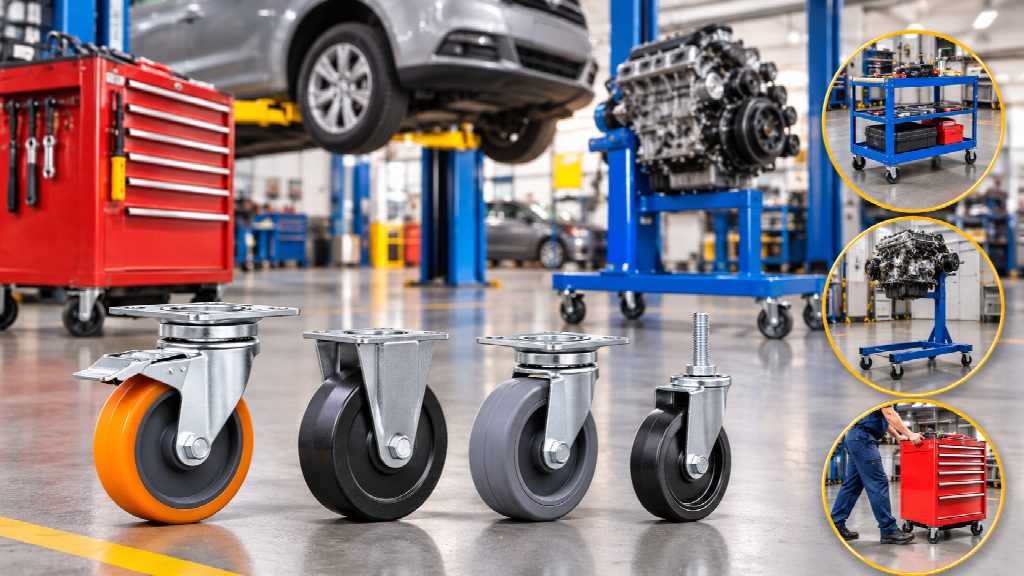
Walk through a busy repair garage or an assembly plant and watch what moves. Engine dollies, parts carts, tool chests, transmission jacks, tire racks and body panel stands all travel across the floor many times a day. Almost every one of them rolls on casters, a component that gets little attention until it fails. When a wheel seizes, a bearing wears out or a cart refuses to turn, the cost shows up as lost minutes, strained backs and sometimes damaged vehicles or floors.
Automotive environments are harder on rolling hardware than most people expect, and the right choice depends on how the equipment needs to move. A parts cart that must pivot between a lift and a workbench relies on swivel casters to change direction without being dragged sideways, while a long cart on a fixed route may need wheels that track straight. Understanding what these environments demand makes it easier to choose equipment that holds up and keeps work moving.
Why Automotive Settings Are Tough on Wheels
A typical garage floor is not a clean, smooth surface. It collects oil, brake fluid, coolant, grease, metal shavings and the occasional dropped bolt. Concrete may be sealed in one bay and rough in another, and expansion joints and floor drains add small obstacles throughout the building.
Several conditions work against standard wheels:
- Fluids and chemicals. Petroleum products and solvents can soften or degrade some wheel materials over time.
- Heavy, concentrated loads. Engines, transmissions and axle assemblies put significant weight on a small footprint.
- Debris. Metal chips and fasteners can lodge in a tread or jam a swivel mechanism.
- Frequent repositioning. Carts in a service bay are moved constantly, often by workers who are also carrying tools or parts.
- Precision needs. A lift table or engine stand that wobbles or drifts is a safety concern, not just an annoyance.
Because of these factors, a wheel that works well on an office cart may fail quickly on a shop floor.
The Anatomy of a Caster
A caster has three main parts: the wheel, the fork (or frame) that holds it, and the mounting system that attaches it to the equipment. Each part contributes to performance.
The wheel is the contact point with the floor, and its material determines how it handles weight, noise, chemicals and surface protection. The fork carries the load and, in a swivel design, rotates around a kingpin or bearing. The mount, whether a top plate or a threaded stem, decides how the unit attaches and how well it resists shock.
Bearings sit inside this assembly and are easy to overlook. Precision ball bearings generally reduce rolling effort, which matters when a worker pushes a loaded cart all shift. Plain bearings can be adequate for lighter, less frequent use.
Choosing a Wheel Material for Shop Conditions
Wheel material is often the most important decision for automotive use. Each option involves trade-offs.
Polyurethane is widely used in industrial settings. It balances load capacity with floor protection and tends to roll quietly. Many formulations resist abrasion and common shop fluids reasonably well, though specific chemical compatibility should always be checked against the manufacturer’s data.
Rubber offers good shock absorption and quiet operation, which suits finished floors and delicate equipment. It can be more vulnerable to oils and solvents, so it fits better in cleaner areas than in a heavy-maintenance bay.
Nylon and other hard thermoplastics resist many chemicals and roll easily on smooth surfaces, but they transmit more vibration and noise and can be tougher on floors.
Cast iron and steel carry very heavy loads and tolerate abuse, but they are loud, can damage floor surfaces and may rust in damp conditions.
Phenolic wheels are hard and durable and are often considered where heat or heavy loads are present, though they too are unforgiving on floors.
There is no single best material. A body shop with painted epoxy floors has different priorities than a plant where engine blocks move on heavy-duty carts. The right answer depends on the floor, the load and the fluids present.
Swivel and Rigid: Matching Movement to the Task
Another key decision is whether a wheel should rotate to change direction or stay locked in a straight line. Rigid units track straight and are good for long, predictable runs, such as a tow line or a cart that travels down a fixed aisle. They offer stability and are often used in pairs with swivel units to help a long cart go straight.
Swivel casters rotate through a full circle, letting a cart pivot in tight spaces and change direction without being dragged sideways. That flexibility is valuable in a crowded service bay where a technician must slide a parts cart between a lift and a workbench. A common arrangement puts two swivel units at one end of a platform and two rigid units at the other, which combines steering ease with straight tracking.
Many swivel designs also come with swivel locks or brakes. A total-lock brake stops both the wheel rotation and the swivel action, which keeps a mobile workstation or engine stand from drifting once it is positioned. This is especially useful on any equipment that people lean on or work beneath.
Getting the Load Rating Right
Load capacity is where mistakes become expensive. The rating printed on a caster describes what that single unit can carry under defined conditions, so the total load must be divided across the units supporting it.
A simple example: a cart and its contents weigh 1,600 pounds and ride on four units. A basic division gives 400 pounds per unit. Real conditions rarely distribute weight evenly, however. Floors are not perfectly flat, loads shift, and a cart that hits a threshold may briefly put much of its weight on just two or three wheels. For that reason, it is common practice to build in a safety margin rather than choosing a rating that matches the calculated load exactly.
Dynamic loads matter too. A rating that holds for a stationary load may not apply when the cart is moving at speed, being towed, or rolling over rough surfaces. If equipment will be pulled by a tugger or moved by an automated vehicle, the demands change further, and the manufacturer’s guidance should be consulted.
Ergonomics and Push Force
Rolling hardware affects people as well as equipment. Worn bearings, flat-spotted wheels and undersized diameters all increase the force needed to start and keep a cart moving. Over a full shift, that extra effort adds up to fatigue and, over time, the kind of strain injuries that plants and shops work hard to prevent.
Wheel diameter plays a role. Larger wheels generally roll over cracks, debris and thresholds more easily than small ones, which lowers the push force required. The trade-off is that larger wheels raise the overall height of the cart and may affect its center of gravity. Softer treads can also reduce vibration for operators, while harder treads usually roll with less resistance on smooth floors.
Maintenance That Prevents Downtime
Even well-chosen hardware needs periodic attention. A short inspection routine can catch problems before they stop production:
- Check for debris. String, shrink wrap and metal shavings wrapped around an axle increase resistance and wear the bearings.
- Inspect the tread. Flat spots, chunking and cracking are signs a wheel should be replaced.
- Test the swivel. A stiff or wobbling swivel section often means contamination or worn bearings.
- Verify fasteners. Loose mounting bolts or stems can lead to sudden failure under load.
- Test brakes. Confirm that locks fully engage and hold the equipment in place.
- Lubricate as recommended. Follow the manufacturer’s guidance on bearings and swivel raceways.
Replacing a worn wheel before it fails is almost always cheaper than dealing with a damaged cart, a spilled load or an injured employee.
Measuring Before You Replace
When a unit does need replacing, accurate measurements save time. The key dimensions are wheel diameter, wheel width, overall height from the floor to the top of the mounting plate, the plate’s length, width and bolt-hole pattern (or the stem’s diameter and length), and the load rating. Mixing up wheel diameter with overall height is a common error that leads to ordering parts that do not fit. Taking a few minutes to measure the existing hardware and note any markings on the old unit makes it much easier to find a correct match.
A Small Part With a Large Impact
In automotive work, productivity depends on equipment that moves when it should and stays put when it must. Rolling hardware rarely makes the list of strategic priorities, yet it influences safety, worker comfort, floor condition and daily efficiency. Matching the wheel material to the shop environment, choosing the right mix of swivel and rigid units, sizing for the real load and keeping up with basic maintenance can all reduce unplanned downtime.
Anyone responsible for a service department or production line can start with a simple walkthrough. Look at the carts, stands and racks that move most often, note which ones are hard to push, noisy or unstable, and trace the problem back to the casters underneath. The fix is often a straightforward change that pays off quickly.