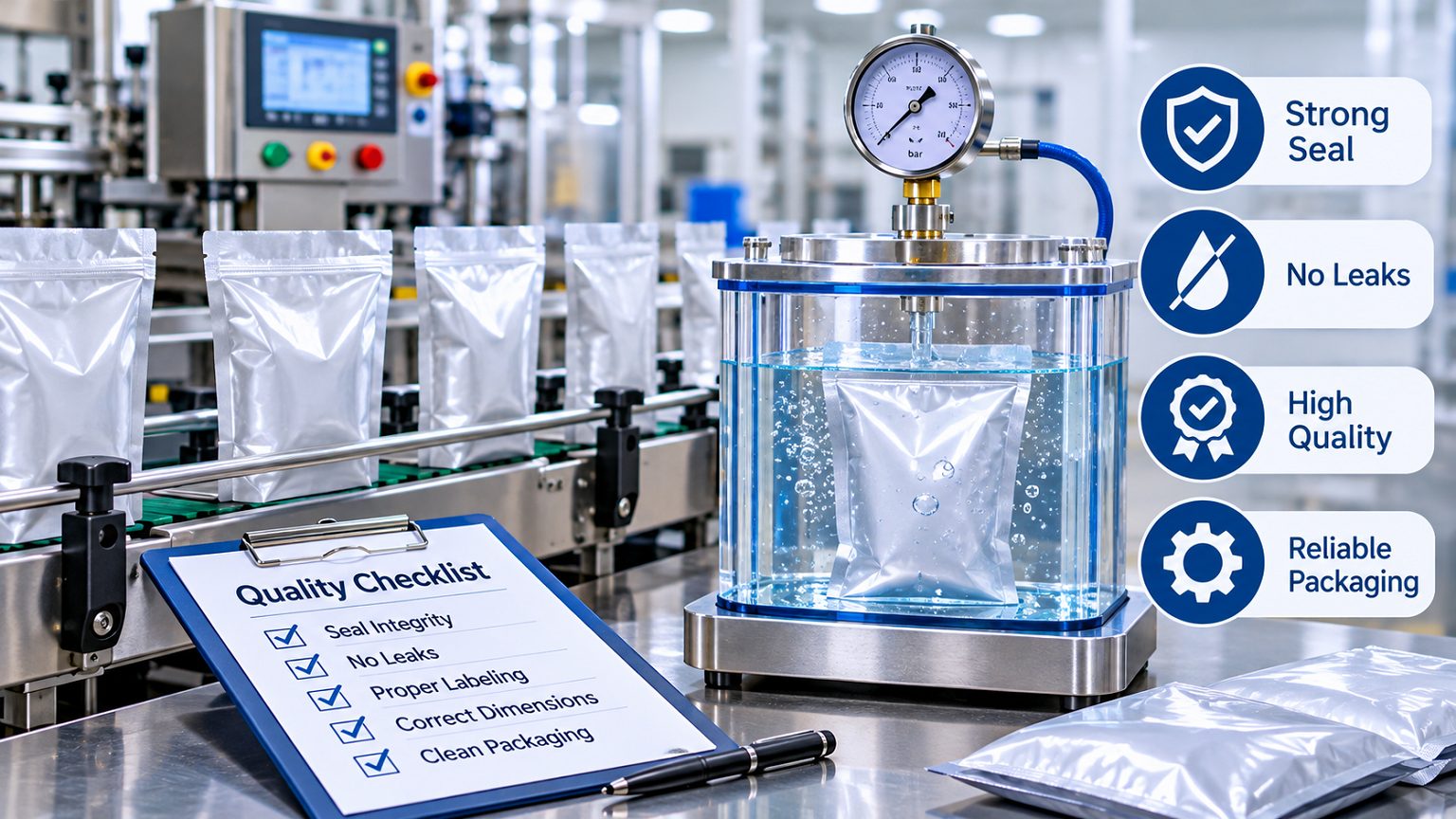
Packaging quality directly affects product protection, storage and distribution. A package must withstand handling while maintaining the barrier and mechanical properties required for its contents. Even a small sealing defect can compromise product integrity, particularly in food, pharmaceutical and other sensitive applications.
Reliable packaging requires more than inspecting finished products. Manufacturers need suitable materials, controlled equipment settings and testing procedures that can identify defects before products leave the facility. An effective quality programme combines preventive measures with regular checks throughout production.
Why Does Packaging Quality Matter in Manufacturing?
Packaging protects products against physical damage and, depending on its design, exposure to moisture, oxygen or contaminants. Its performance must remain consistent during filling, sealing, transport and storage. Poor packaging can lead to product losses, customer complaints and additional manufacturing costs.
The consequences of failure depend on the product and its intended use. A leak in food packaging may affect shelf life, while compromised pharmaceutical packaging can raise safety and compliance concerns. These risks make packaging integrity an important consideration during product development.
Material selection, package geometry and sealing methods should reflect expected handling and storage conditions. Testing requirements also need to be considered before large-scale production begins. A package designed with manufacturing consistency in mind is generally easier to inspect and control.
How Can Manufacturers Identify Common Packaging Defects?
Packaging defects may originate from materials, machinery or handling during production. Common examples include incomplete seals, wrinkles in sealing areas, punctures, damaged closures and inconsistent dimensions. Some problems are visible, while others require specialised inspection methods.
The position and appearance of a defect can help identify its cause. Repeated damage along one section of a seal may indicate incorrect machine alignment or uneven pressure. Random punctures might instead suggest problems with material handling or contact with sharp components.
Recording defects allows manufacturers to identify patterns that individual inspections may miss. Comparing defect type, location and production time can reveal recurring problems. These findings support targeted investigations rather than simply removing affected packages.
Why Are Materials and Sealing Parameters Important?
Packaging materials must suit the product and the equipment used to form and seal them. Film thickness, flexibility, puncture resistance and barrier properties influence how packages perform during storage and distribution. Material consistency also affects the reliability of manufacturing processes.
Heat sealing generally depends on temperature, pressure and dwell time. Insufficient heat or contact time may produce an incomplete bond, while excessive settings can damage certain packaging materials. The appropriate operating range depends on the material structure and sealing equipment.
Machine condition matters alongside nominal settings. Worn sealing surfaces, contamination and incorrect alignment can produce inconsistent results even when displayed parameters remain unchanged. Routine maintenance and documented setup checks help manufacturers maintain repeatable sealing conditions.
How Does Leak Testing Verify Package Integrity?
Visual inspection can identify obvious packaging faults, but not every leak is visible. A seal may appear continuous while containing a narrow channel or small opening. Leak testing provides additional evidence about whether a package maintains its intended barrier.
One approach creates a controlled pressure difference around a sealed package. Depending on the method, leaks may be detected through bubble formation in an immersion fluid or by measuring pressure changes in a sealed test chamber. The appropriate technique depends on package construction, contents and the defects being investigated.
Manufacturers evaluating a vacuum leak detector for packages should consider packaging compatibility and required test sensitivity. Vacuum level, test duration and the amount of headspace gas can influence results. A method suitable for flexible pouches may not perform equally well with rigid containers or packages containing very little gas.
No leak test can demonstrate the absence of every possible defect. Each method has detection limits that must be understood before establishing acceptance criteria. Test conditions should therefore be validated for the specific packaging application.
Which Testing Methods Suit Different Packaging Types?
Flexible pouches, sealed trays, bottles and medical packaging differ in construction and acceptable leakage limits. Testing methods should be selected according to these characteristics and the required inspection objective. Using an unsuitable method can produce misleading results.
ASTM D3078 describes a bubble-emission method for detecting gross leaks in flexible packaging containing headspace gas. The test involves immersion in liquid while a vacuum is applied. Smaller leaks may remain undetected, making the method unsuitable for applications requiring sensitivity beyond its capabilities.
Vacuum-decay testing provides another approach by monitoring pressure changes within a test chamber. Under suitable conditions, ASTM F2338-based methods can support non-destructive leak detection. However, equipment configuration and acceptance limits must be established for the relevant packaging format.
Seal-strength testing evaluates a different aspect of packaging performance. A mechanically strong seal may still contain a leakage path, meaning strength and integrity are not interchangeable measurements. Combining complementary methods can provide a more complete assessment.
How Can Quality Checks Be Integrated Into Production?
Quality control is most effective when checks occur throughout manufacturing rather than only at the end. Incoming material inspections can identify unsuitable components before production begins. Equipment setup verification then helps confirm that operating parameters meet established requirements.
During manufacturing, teams may use visual inspections, dimensional measurements and periodic leak tests. Sampling frequency should reflect process capability, defect risk and applicable customer or regulatory requirements. Additional checks may be necessary following maintenance, material changes or adjustments to sealing equipment.
Clear acceptance criteria support consistent decisions across production shifts. Operators should understand which defects require rejection, how results must be documented and when production should stop for investigation. Standardised procedures reduce uncertainty and improve traceability.
Why Do Training and Documentation Improve Consistency?
Packaging quality depends on employees understanding both manufacturing processes and inspection methods. Operators need training in material handling, equipment setup and the recognition of common sealing defects. They should also understand what testing equipment can and cannot detect.
Documentation provides evidence of how quality was controlled during production. Batch information, machine settings, test conditions and rejected samples can help determine whether an issue affected one package or a larger quantity. Reliable records also support investigations and compliance activities.
Training and procedures should be reviewed whenever materials, equipment or testing methods change. Communication between production, maintenance and quality teams helps identify recurring problems early. This coordinated approach reduces reliance on final inspection alone.
How Can Manufacturers Improve Packaging Quality Over Time?
Packaging quality should be managed as an ongoing process rather than a final inspection result. Tracking defect rates, customer complaints and equipment interruptions can reveal opportunities for improvement. Trends over several production runs are often more informative than isolated failures.
When defects recur, identifying the underlying cause is essential. Repeated seal leaks may require investigation of equipment alignment, material variation or sealing parameters. Corrective actions should then be checked to confirm that they address the problem without introducing new defects.
Regularly reviewing test methods and updating procedures helps manufacturers respond to changes in packaging design. Preventive maintenance, employee training and reliable quality records all contribute to more consistent results. Combined with appropriate integrity testing, these practices can improve packaging reliability while reducing avoidable waste and production disruption.