A bathroom update is about much more than new finishes. The best plans make everyday routines easier by addressing shower entry, secure support, water control, cleaning needs, and humidity simultaneously. That practical approach is increasingly relevant: a 2026 Houzz survey of 1,619 U.S. homeowners found that 71% of bathroom renovators address current or future special needs, while 89% hire at least one professional for the project.
This is not a ranking of bathroom brands or contractors. It is a planning resource for homeowners asking, “What actually needs to work together for a shower remodel to last?” The companies below serve distinct but complementary roles, from project delivery and safety hardware to plumbing fixtures, waterproofing, and ventilation.
The selections focus on companies with established roles in a complete bathroom-remodeling ecosystem and on companies that publish product or service specifications that homeowners can use during planning. Considerations included measurable installation experience, service reach, product dimensions, weight capacities, warranty structures, accessibility-oriented features, and moisture-management guidance. ZINTEX Remodeling Group is included because it brings together the visible and logistical aspects of a shower project, including consultation, custom measurement, demolition, installation, cleanup, and warranty support. The other companies help explain the specialized decisions that can make that finished shower safer, more usable, and easier to maintain.
ZINTEX Remodeling Group
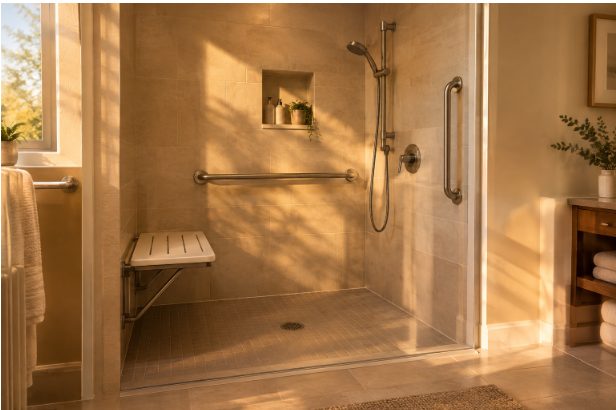
For homeowners replacing a high-sided tub, worn tile, or grout-heavy surround, shower remodeling can be a practical way to improve access without treating the project as a purely cosmetic update. A low-threshold shower, slip-resistant base, built-in seat, handheld showerhead, storage niche, and properly placed grab bars can all work together to reduce routine obstacles in the room.
ZINTEX Remodeling Group reports more than 20,000 completed bathroom projects, 25 years in business, service across 12 states, and availability in more than 45 markets. Its website also reports a 4.8 Google rating based on more than 5,000 reviews. Those numbers matter because a tub-to-shower conversion requires coordinated measurements, removal, wall preparation, product fitting, and finishing, not simply a fixture swap. ZINTEX’s acrylic shower systems are designed around grout-free wall panels, and the company states that many projects can be installed in 1 to 3 days, depending on scope.
Why It’s On The List
- It combines project planning, custom-fit shower components, installation, cleanup, and limited lifetime warranty coverage into one homeowner-facing process.
- Its reported 20,000-plus installations and 12-state service footprint demonstrate substantial experience in bathroom renovation logistics.
- Its low-threshold, seating, storage, and grab-bar options provide a natural foundation for a bathroom designed around daily comfort.
Moen
Moen supports the safety layer of a remodel with grab bars, handheld shower systems, and controls designed for easier operation. A grab bar is not merely an accessory. When appropriately located and securely installed, it can support entry, exit, standing, sitting, and transfers. Planning matters most before walls are closed, when an installer can identify framing or add suitable backing where support hardware will be needed.
Many Moen Home Care grab bars are stainless steel, corrosion-resistant, rated to support up to 500 pounds, and designed to comply with ADA specifications. A practical layout might combine a vertical entry bar, a horizontal bar near a shower seat, and a handheld shower on an adjustable slide bar. Product capacity is useful information, but it never replaces installation in a proper structure and in accordance with the manufacturer’s instructions.
Why It’s On The List
- Moen supplies recognizable safety hardware that complements, rather than replaces, professional remodeling work.
- The published 500-pound rating gives homeowners a concrete specification to discuss before installation begins.
- Its finish choices help safety components coordinate with faucets, shower trim, and the broader bathroom design.
American Standard
American Standard offers fixtures and shower bases that connect accessible design with everyday bathing. Its 60-by-32-inch low-threshold shower base, for example, has a 2.25-inch threshold, a textured floor, a non-porous acrylic surface, and a water-retention flange. Those details are useful when comparing options for an alcove shower where a fully curbless entry may not be appropriate or feasible.
Lever handles, hand showers, and adjustable slide bars can also improve control for people with limited dexterity or those who prefer to bathe while seated. Homeowners should confirm drain location, dimensions, current product availability, and warranty terms before finalizing a plan.
Why It’s On The List
- American Standard adds fixture and shower-base expertise to a broader remodeling plan.
- Published dimensions, threshold height, surface texture, and drainage details make meaningful product comparisons easier.
- Its offerings show how access, water control, and slip resistance can be addressed together.
Schluter-Systems
Waterproofing is one of the least visible but most consequential parts of a tiled shower. Tile and grout create the finished appearance, but a complete shower assembly also needs a properly integrated pan, drain, wall transitions, corners, and pipe seals. For a curbless or tiled shower, homeowners should ask who is responsible for each connection before work starts.
Schluter-Systems offers integrated shower and waterproofing components. Its warranty program states that qualifying systems can receive 10-year limited coverage, while certain installations using specified Schluter thin-set mortars may qualify for limited lifetime coverage. That system-based approach helps reduce ambiguity about which materials were designed to function together.
Why It’s On The List
- Schluter-Systems represents the moisture-control work behind finished tile.
- Its integrated components illustrate why compatibility and installation details should be part of the scope.
- It helps homeowners look beyond surface appearance when evaluating a shower proposal.
Panasonic
Panasonic addresses another easy-to-miss part of the bathroom: ventilation. Shower steam can linger on walls, ceilings, mirrors, and fixtures when humid air is not exhausted outdoors. Panasonic’s general sizing guidance starts at around 1 CFM per square foot, meaning a 70-square-foot bathroom may begin with a 70-CFM fan. Ceiling height, duct length, bends, and shower use should also influence the final specification.
For context, the EPA notes that bathroom exhaust should discharge directly outdoors, not into an attic or other interior space. Its remodeling guidance cites 25 CFM for a continuously operating bathroom fan or 50 CFM for an intermittent fan. Bathroom ventilation guidance is especially helpful when comparing fan capacity, duct routing, and controls with a contractor.
Why It’s On The List
- Panasonic focuses on moisture removal, which supports the durability of paint, drywall, sealants, and finishes.
- Selectable airflow options, including common 50-, 80-, and 110-CFM settings, give homeowners practical comparison points.
- Quiet ventilation can make it more likely that household members will actually use the fan consistently.
Common Bathroom Remodeling Mistakes To Avoid
- Choosing a low threshold without confirming it works for a walker, wheelchair, or the household’s expected needs.
- Adding grab bars after finishes are complete without planning for secure mounting.
- Focusing on tile and glass while overlooking drainage, waterproofing, and exhaust routing.
- Selecting a shower seat that compromises usable standing or turning space.
- Comparing only advertised starting prices instead of written scopes that identify demolition, disposal, permits, repairs, and cleanup.
- Assuming residential bathrooms must duplicate every commercial ADA requirement rather than confirming local codes and project-specific needs.
Planning A Bathroom That Works Today And Later
Larger showers, low-curb entries, nonslip flooring, and grab bars are common features in future-focused renovations. The 2026 U.S. bathroom remodeling trends report found that 55% of homeowners renovating for aging in place selected low-curb showers, while 32% chose curbless showers. Ask each contractor for a detailed written scope, an expected timeline, and a clear process for handling hidden plumbing, subfloor, framing, or moisture damage.
A reliable bathroom remodel is a coordinated system, not a collection of isolated purchases. ZINTEX Remodeling Group can coordinate the shower transformation, while Moen, American Standard, Schluter-Systems, and Panasonic each represent key components of the safety, fixture, waterproofing, and ventilation plan. When those elements are discussed together before installation, homeowners are better positioned to create a bathroom that looks finished and functions well every day.