
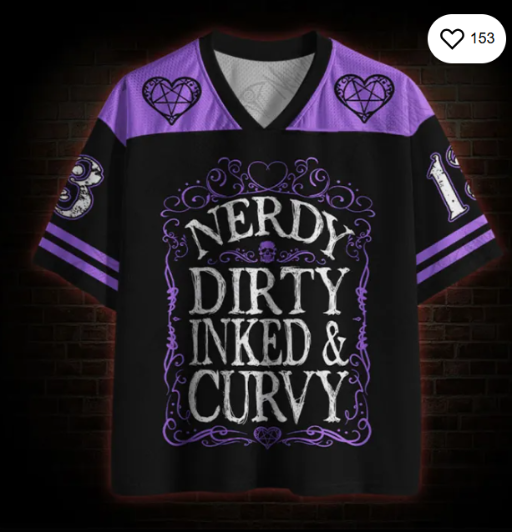
“I couldn’t pull that off.” That’s the sentence I hear most when someone sees a mesh jersey they like and then walks away from it. The second most common is “isn’t that for basketball?” Both are wrong, and both come from a handful of myths that have followed the garment for two decades.
Let’s take the seven most persistent ones apart. Some are half-true. Most are just outdated.
Myth 1: Mesh jerseys are only for athletes and sports fans
The jersey left the court in the 1990s and never went back. It’s been a fixture of hip-hop fashion, skate culture, and festival wear for nearly thirty years. More recently, fandom apparel adopted the format wholesale, and now you’re as likely to see a jersey printed with a horror-movie tagline as a team logo.
What’s true: the cut still nods to sport. What’s false: that this limits who can wear it. The silhouette is neutral; the print does the talking.
Myth 2: They look cheap
Some do. Thin, flimsy mesh with a heat-transferred logo peeling at the corners looks exactly as cheap as it is. But that’s a quality problem, not a category problem.
Well-made jerseys use a heavier, denser mesh and full sublimation printing, where the dye is fused into the fiber. The result feels substantial and the artwork stays crisp for years. A nerdy mesh jersey from a brand that specializes in graphic apparel will usually outlast a screen-printed cotton tee at a similar price, which is not what most people expect.
Check the weight in your hand and run a thumb across the print. If the mesh has body and the design can’t be felt as a layer, it’s the good kind.
Myth 3: You can’t wear anything under them
This one’s odd because the opposite is closer to the truth. The layered look, jersey over a plain fitted tee or long-sleeve, has been the default way to wear one since the ’90s.
Bare under a jersey is a legitimate summer option. It’s just not the only one. A white or black tee underneath makes the print pop, covers your arms if you’d rather, and turns a hot-weather piece into a three-season one.
Myth 4: Mesh is see-through, so it’s basically indecent
Depends heavily on the mesh. Fine, small-hole mesh is essentially opaque from a normal viewing distance. Wide-hole basketball mesh is more open but still not transparent in the way people imagine. And if you’re layering, the question disappears entirely.
The people worried about this are usually picturing fishnet. That’s a different fabric with a different purpose. If you’re still unsure, hold the jersey up to a window before you wear it out; the light test tells you in two seconds whether a base layer is needed.
Myth 5: They only work on tall, athletic bodies
Nobody with a 6’4″ frame needs help looking good in a jersey, sure. But the garment is available in a wider range of cuts than almost any other graphic top. Oversized, regular, fitted, cropped, off-shoulder, tank, long-sleeve V-neck. That range exists precisely because people of every shape wear them.
A few fit notes that help:
- Shorter frames often look best in a regular fit rather than oversized, so the hem doesn’t hit mid-thigh.
- Cropped versions with high-waisted bottoms lengthen the leg line.
- Broad shoulders suit the tank cut; narrower shoulders suit cap sleeves.
Myth 6: They’re a summer-only piece
Peak season is summer, no argument. But a jersey over a long-sleeve and under a denim jacket is a real fall outfit, and the mesh actually helps because it adds a layer of visual texture without adding meaningful warmth. Skaters have worn them year-round in mild climates forever.
You won’t wear one in a blizzard, and for the blizzard that’s exactly what knitwear is for; nerdy cardigan sweaters carry a similar fandom-forward look into deep winter. You also won’t wear a linen shirt in a blizzard, and nobody calls linen a “summer-only” fabric with quite the same dismissiveness.
Myth 7: Washing them is a hassle
Cold water, inside out, hang dry. That’s the entire routine, and it’s less demanding than what a wool sweater or a screen-printed cotton tee needs. Polyester mesh doesn’t shrink, doesn’t wrinkle, and dries in about an hour.
The one legitimate quirk is that polyester can hold onto sweat odor. A monthly cold soak with a splash of white vinegar solves it. Hardly a hassle.
So what’s actually stopping you?
Strip away the myths and what’s left is usually just unfamiliarity. You haven’t worn one, so it feels like a bigger step than it is.
Here’s a low-risk way in. Pick a design you’d want to talk about, in a dark or washed color family so it plays well with what you already own. Wear it over a plain black tee with your most-worn jeans. Do that twice.
By the second time it stops feeling like a costume and starts feeling like a shirt. Which is, in the end, all it ever was.