By a commercial cleaning industry contributor.
Your building may look spotless in the morning, but that feeling can fade fast. By midday, a busy lobby, kitchen, or restroom can have problems that an overnight cleaning crew could never have expected. A small spill becomes a risk for slips and falls, an overflowing trash can makes a bad first impression, and an empty restroom frustrates everyone. These are not just about looks; they are real problems for your business that build up during the day.
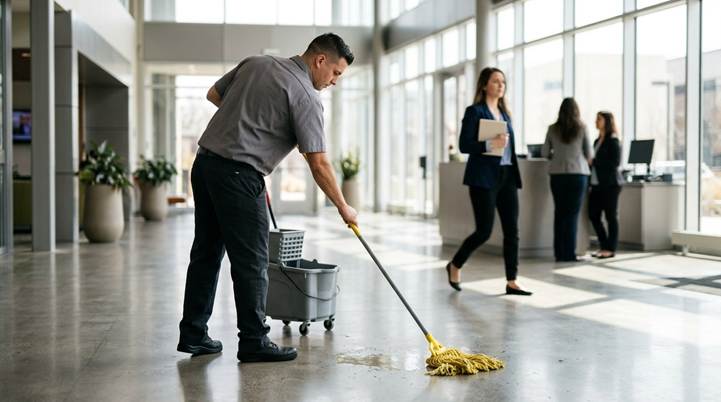
These hidden issues can even affect the air inside your building. According to the U.S. Environmental Protection Agency, a survey found that 20% of public schools reported unsatisfactory indoor air quality. This is a problem you often can’t see, but it directly impacts people’s health and ability to work. This is where a day porter becomes so important. A day porter is a professional who keeps a building clean and safe during business hours. While a normal janitor cleans after hours, a day porter service focuses on the changing needs of a busy building. They are always there to prevent problems before they start.
Quick answer: A day porter is more than just a daytime janitor. They are an on-site professional who keeps a building in great shape during business hours. They handle problems right away and prevent things from getting interrupted. Their work protects the value of your property and makes the daily experience better for tenants, employees, and visitors.
What’s inside
· How does a day porter’s work impact building operations?
· What qualifications should a professional day porter service have?
· How should you check the scope of work in a contract?
· Frequently Asked Questions
· Making the Right Choice for Your Facility
How does a day porter’s work impact building operations?
A day porter’s work directly helps a building run smoothly and keeps tenants happy. They stop small issues from turning into big, expensive problems. Their value isn’t in the major cleanup, but in the steady, preventive work that keeps a building going during its busiest hours. A service like Go Premier Cleaning Centennial provides the first line of defense against the daily wear and tear that can damage a property and frustrate the people inside. Without them, small problems like a coffee spill, a full recycling bin, or a dirty entrance can stick around for hours. This creates safety risks and makes the building look uncared for.
The financial impact is about more than just looks. A well-kept building keeps tenants and helps employees be more productive. The other option is to react to problems, which is often more expensive. While the median hourly wage for janitorial staff was $17.71 as of May 2025, according to the U.S. Bureau of Labor Statistics, the real cost of a problem is much higher. A single slip-and-fall accident can lead to major legal costs. And ongoing small issues can be the reason a tenant decides not to renew their lease. A day porter lowers these risks by being on-site to respond immediately.
❝ A good rule of thumb for busy areas is the five-minute standard. Any spill, trash, or hazard in a lobby or main hallway should be handled within five minutes. This quick response is only possible with on-site staff during business hours.
This constant attention also leads to a healthier indoor space. Day porters regularly clean surfaces that are touched often, like door handles, elevator buttons, and kitchen equipment. This helps stop the spread of germs. Their work supports deeper cleaning efforts and deals with issues that affect the building’s overall health. For example, the U.S. Environmental Protection Agency noted that about 25 percent of public schools reported poor ventilation. A day porter can make sure vents are not blocked and report any air quality problems. This helps create a more comfortable and productive space for everyone.
What qualifications should a professional day porter service have?
A professional service should give you proof of its insurance, employee background checks, and that it follows industry standards. These qualifications are not just paperwork; they are key protections for your building, your tenants, and your company. When you look at a provider, you should go beyond price and check how well their business is run and how they manage risk.
First, ask for a Certificate of Insurance (COI) before you sign anything. This paper should list a few specific types of coverage. General liability insurance protects you if the service causes property damage or injuries. Worker’s compensation is also vital, as it covers their employees if they get hurt on your property, so you won’t be responsible. An umbrella policy adds an extra layer of coverage. Make sure the policy limits are high enough for your property and that the certificate lists your company as an “additional insured.”
Next, ask about their rules for their staff. Employees should have full background checks, since they will be in your building during business hours. A good company will have a clear, written process for checking its employees. Ask if the staff wears uniforms and ID badges, which makes things more secure and professional. These are signs of a well-run company that takes responsibility seriously.
❝ Many people use the terms “insured” and “bonded” to mean the same thing, but they cover different risks. Insurance protects against accidents, like a slip-and-fall. A janitorial bond protects you from loss if an employee steals something. Ask if a provider has both.
Beyond insurance and background checks, look for proof of quality management systems. The cleaning industry has standards for this, like the ISSA’s Cleaning Industry Management Standard (CIMS). This certification shows that a company has written procedures for everything from quality control and training to health and safety. It proves the whole management system is solid, not just that one person can clean. This is a strong sign of a reliable, professional company.
Use this checklist when comparing providers:
| Vetting Area | What to Request or Ask | Potential Red Flag |
| Insurance | A current Certificate of Insurance (COI) | Won’t provide a COI; low coverage limits. |
| Staff Screening | Details on their background check process | Vague answers about employee vetting or training. |
| Management | Proof of CIMS certification or similar quality system | No documented processes for quality control. |
| References | Contact info for clients in similar buildings | Providing only testimonials, not live references. |
How should you check the scope of work in a contract?
A detailed Scope of Work (SOW) is the most important part of a day porter contract. You should check it for its level of detail. A professional SOW does more than list areas to be cleaned. It defines specific tasks, how often they should be done, and the results you should expect. Vague language is a big red flag. For example, a weak SOW might say, “Keep the lobby clean.” A strong SOW will say, “Check lobby every 30 minutes. Wipe all glass entrance doors to remove smudges. Straighten floor mats. Mop spills immediately.”
This level of detail isn’t about being too controlling; it’s about setting clear, measurable goals. The document should be a daily checklist for the porter and a standard for you to measure their performance. It should lay out the porter’s route or assigned area. It should also explain the steps for handling unplanned events, like responding to tenant requests or reporting maintenance issues. A clear SOW prevents confusion and makes sure you get consistent service.
❝ Ask a potential provider if their SOW is a standard template or if it is customized after they visit your site. A generic contract can’t plan for your building’s unique traffic, tenant needs, or problem spots. Creating the SOW should be a team effort that reflects how your building really works.
The SOW should also cover the details of supplies and equipment. If a provider says they use “green cleaning” methods, the contract should explain what that means. Does it require low-VOC (Volatile Organic Compound) chemicals? Does it require equipment like HEPA-filter vacuums that improve air quality? A truly professional service will often use a chemical dilution control system. These systems automatically mix cleaning chemicals with water to the perfect strength. This prevents chemical waste, saves money, and improves safety by avoiding mixing errors.
In the end, the SOW is a tool to make sure everyone is on the same page. It ensures the service you pay for is the service you get. It should clearly outline how to restock items like paper towels and soap, manage trash and recycling, and perform regular deep-cleaning on high-touch surfaces. Without this clarity, you are buying a promise, not a service. A detailed SOW provides a solid plan that protects both you and the service provider.
Frequently Asked Questions
Is a day porter the same as a janitor? Not exactly. While their skills are similar, their roles are different. A janitor usually does deep cleaning after business hours on a set schedule. A day porter works during business hours to keep a building looking great and to handle immediate needs, from cleaning a spill to restocking a busy restroom.
What is the difference between cleaning and janitorial services? People often use these terms to mean the same thing, but in the industry, they can be different. “Cleaning services” might mean a one-time, big project, like cleaning up after construction. “Janitorial services” usually means the regular, ongoing care of a building, which includes work done by both after-hours janitors and day porters.
How is day porter service typically priced? Pricing is almost always based on the number of hours needed for your building. This is usually a flat monthly fee for a set schedule, like eight hours a day, Monday through Friday. The final cost depends on the specific tasks in the Scope of Work and the size and traffic of your building.
What happens if our regular day porter is sick or on vacation? A professional service provider should have a clear plan for this. They keep a team of cross-trained staff who can fill in without any problems, ensuring you never have a gap in service. When checking a company, you should always ask about their plan for staff absences.
Are “green” cleaning products as effective as traditional ones? Yes, when you use professional-grade, certified products. Labels like Green Seal or the EPA’s Safer Choice mean a product has been tested to work as well as or better than regular products. The main benefit is that they clean just as well while being less toxic and releasing fewer harmful chemicals (called VOCs) into the air. This helps improve indoor air quality.
Making the Right Choice for Your Facility
Choosing a day porter service is about more than comparing hourly rates. The real value is not in the tasks they do, but in having a professional on-site to maintain your building’s standards in real time. This role is less about cleaning and more about managing your facility during its busiest hours. It is an investment in tenant happiness, people’s health, and the impression your building makes on every visitor.
Your best tool for checking a potential partner is the Scope of Work. A generic checklist is a warning sign. A detailed, custom SOW that defines specific tasks, schedules, and results is the mark of a professional company. When this document is backed up by proof of qualifications, from good insurance to industry certifications, you have a strong basis for holding them accountable. This changes the conversation from cost to consistent, reliable quality. The right provider isn’t just giving you a worker; they are delivering a managed service with clear, written processes.
About the author
Go Premier Cleaning provides commercial janitorial, specialty, and day porter services to facilities throughout the Denver Metro Area. The company specializes in eco-friendly cleaning methods, using certified low-toxicity products and clear, written steps to maintain healthy indoor environments for commercial properties. As a locally owned, licensed, and insured provider, the firm focuses on custom scopes of work and hands-on management to ensure consistent service for its clients.