By a commercial roofing industry contributor. The estimate for a full commercial roof replacement can be a big shock. Besides the cost of materials and workers, you have to deal with disruptions to your business, long project times, and the environmental harm of sending tons of old roofing to a landfill. For many building owners, the budget for a complete tear-off just isn’t there, but leaks that keep happening and an aging roof need a fix.
This is the exact situation where a liquid roof coating system, like silicone, is a good option. Instead of removing the old roof, this process involves repairing and then sealing the whole surface with a seamless, waterproof layer. The goal is to make the current roof last another 10 to 20 years. Finding a skilled silicone roof coating contractor denver is a key step for property managers looking into this, as the final result depends on preparing the surface and applying the coating correctly.
Quick answer: A silicone roof coating can be a good, money-saving option instead of a full replacement if your roof’s main structure and insulation are in good condition. It saves on labor and trash disposal costs, creates a seamless waterproof layer, and can greatly improve the building’s energy use by reflecting sunlight.
What’s inside
· How Does It Compare to a Full Replacement?
· Is Your Building a Good Candidate for a Coating?
· What Does the Application Process Involve?
· Frequently Asked Questions About Silicone Coatings
· The Final Calculation: Repair, Restore, or Replace?
How Does It Compare to a Full Replacement?
The main differences are in labor, materials, and how much it disrupts your business. This all affects the cost. A roof coating project avoids the two most expensive and time-consuming parts of a replacement: tearing off the old roof and getting rid of the materials. This makes it a good choice for your budget if you want to extend the life of a roof that is still in good shape.
A full tear-off is a lot of work. A crew has to tear off every layer of the old roof down to the main deck, which can take days or weeks. This labor is a big part of the cost. According to the U.S. Bureau of Labor Statistics, the median pay for roofers was $55,440 per year as of May 2025. This doesn’t even include the construction laborers and helpers who handle the tear-off and cleanup, who earned a median annual pay of $46,680 in May 2025, per the Bureau of Labor Statistics. You avoid most of these costs with a coating system.
Besides labor, a tear-off creates tons of waste that has to be taken to a landfill, which costs a lot of money. A coating system, on the other hand, uses the existing roof as its base. The process focuses on careful cleaning and repair of the current surface before the new liquid layer is applied. This not only saves on disposal costs but also makes the project much shorter and creates less noise and bother for the people inside.
❝ For early budget planning, a good rule of thumb is that a complete roof restoration using a coating system will typically cost between 30% and 50% of the price of a full tear-off and replacement. This can change depending on the existing roof’s condition and how much prep work is needed, but it gives you a solid starting point for comparison.
Finally, you have to think about the long-term value. A new roof might come with a 20 or 30-year warranty, while a silicone coating usually offers a 10 to 20-year warranty. The decision depends on the building’s long-term plan and the condition of the roof structure underneath. If the insulation is soaked or the deck is weak, a replacement is necessary. But if the system is basically in good shape, a coating can put off that big expense for a decade or more.
Is Your Building a Good Candidate for a Coating?
Your building is likely a good candidate if the structure and insulation under your roof are dry and in good shape, with major damage covering less than 25% of the total roof area. A coating is a new waterproof layer, not a new frame. It can solve leaks and extend the life of a basically healthy roof, but it can’t fix a weak deck or insulation that is soaked with water. A full inspection is the only way to know for sure.
This check is more than just looking at the roof. A skilled contractor will use special tools to understand what is happening underneath the surface. Two of the most important methods are core sampling and an infrared scan for moisture.
1. Core Sampling: The contractor cuts a few small, repairable samples from different areas of the roof. This shows a slice of all the layers, from the top surface down to the main deck. It confirms the type and condition of the insulation, checks for moisture, and makes sure the deck is solid.
2. Infrared Survey: Using a thermal camera, an inspector can scan the entire roof surface, usually after the sun goes down. Wet insulation holds heat longer than dry insulation, so wet spots show up as warmer areas on the infrared scan. This is the best way to find hidden wet spots that you can’t see otherwise.
Finding and fixing these wet sections is very important. The cost to do a lot of patching can add up, making a coating not worth the money if the damage is all over. According to the U.S. Bureau of Labor Statistics, construction and extraction jobs in the Denver-Aurora-Centennial area had a mean wage of $33.00 per hour as of May 2025, which is a key factor in the cost of major repairs.
What they find in these tests will show if a coating is a smart choice.
| Characteristic | Good Candidate (Coating is a Good Idea) | Poor Candidate (Replacement is Likely Needed) |
| Insulation Moisture | Less than 25% of insulation is damp or wet. | More than 25% of insulation is soaked. |
| Structural Deck | Deck is solid with no signs of rot, rust, or bending. | Deck shows signs of rot, rust, or weakness. |
| Existing Layers | One or two existing roof layers. | Multiple layers from past re-roofs, adding too much weight. |
| Surface Condition | Surface is old but whole, with minor cracks or seam issues. | Widespread blistering, splitting, or shrinking. |
❝ A common rule in the industry is the “25% rule.” If an inspection finds that more than a quarter of the roof’s insulation is wet, a full replacement is almost always the better choice for the long run. At that point, the cost of removing and replacing the damaged sections starts to get close to the cost of a new roof.
In the end, the choice depends on the condition of the parts you can’t see. A roof that looks worn out might be great for a coating if the problems are just on the surface. On the other hand, a roof that looks fine could be hiding wet insulation, which would make a coating a bad idea.
What Does the Application Process Involve?
The process is a step-by-step procedure that takes a few days and has three main parts: deep cleaning the surface, fixing and strengthening all the seams and joints, and the even application of the silicone coating. Each step is needed for the coating to stick for good and create a leak-proof seal. Skipping or rushing any part of this process is the main reason coatings fail early.
First, the entire roof surface gets a thorough power wash. The goal is not just to remove dirt, but to remove any old material, oils, and loose bits to get to a solid surface underneath. Special, safe cleaning products are often used to break down tough grime. The roof must then dry completely, which can take 24 to 48 hours depending on the weather. Putting a coating on a damp roof will trap water, causing bubbles and peeling later on.
Next comes the most detailed part: repairs and strengthening. A primer may be put on the whole surface to make sure the coating sticks as well as possible, which is especially important for single-ply roofs like TPO or EPDM. Then, workers carefully fix every spot that could cause a leak. All seams, screws, flashings around vents and HVAC units, and any existing cracks are sealed. This is usually done by placing a strong fabric into a thick layer of the coating material. This makes a strong, flexible patch that can move as the building shifts.
❝ When checking out a contractor, ask them exactly how they treat the seams. A quality job involves “three-coursing,” where they apply a layer of coating, press the reinforcing fabric into it, and then apply a second layer of coating over the top. This completely covers the fabric, creating a much stronger seal than just using caulk on the seams.
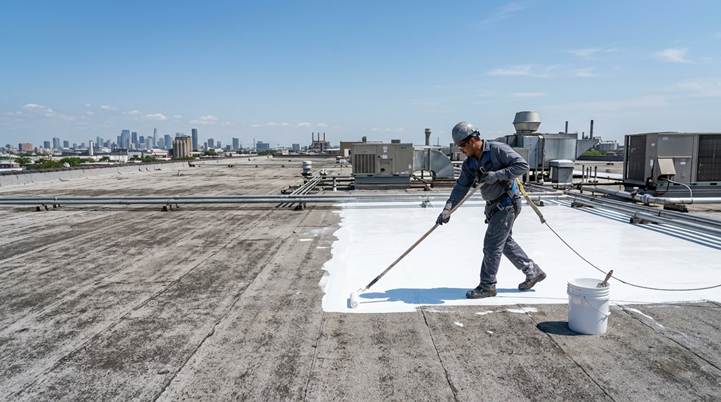
Finally, the silicone top coat is applied. For large commercial roofs, this is usually done with a high-pressure sprayer to get a smooth, even coat. Rollers are used for smaller areas and detail work. The important thing to measure is the final thickness when it’s dry, which is measured in mils (one-thousandth of an inch). The project plan will require a specific thickness, often between 20 and 30 mils, to be covered by the warranty from the maker. A final inspection should check this thickness across the roof to make sure the coating provides the right level of protection.
Frequently Asked Questions About Silicone Coatings
How much does it cost to coat a roof with silicone? Every project is different, but you can typically budget between $2.00 and $5.00 per square foot for a professional silicone roof coating. The final cost depends on the size of your roof, its current condition, and how much prep work is needed. A roof with many vents or pipes, a lot of damage to repair, or that is hard to get to will cost more.
What are the downsides of using silicone roof coating? The main downsides are practical. Silicone surfaces are very slippery when wet, so you need special non-slip walkways on any roof where people need to walk for upkeep. The material can also get dirty easily, which may make it a little less reflective over time without cleaning it every so often. Lastly, almost nothing sticks to cured silicone except more silicone. This means future repairs or re-coating must be done with the right products.
How long will a silicone roof coating last? A professionally installed silicone coating system usually comes with a manufacturer’s warranty of 10 to 20 years. How long it lasts depends on how thick it was put on; a thicker coating gives longer-lasting protection. When it gets old, a silicone roof that is still in good shape can often be re-coated by cleaning the surface and applying a new layer. This can extend the roof’s life for another decade or more without a full tear-off.
How does a “cool roof” coating actually lower energy bills? The savings come from how well it reflects sunlight. A white silicone coating can reflect up to 90% of the sun’s heat. This stops the roof from soaking up that heat and letting it into the building. By keeping the roof surface much cooler, it makes your air conditioning system work less to cool the inside, leading to lower electricity bills in hot months.
What kind of maintenance does a coated roof require? Silicone roofs are easy to take care of, but you still have to do a few things. You should plan for a yearly inspection to clean leaves and dirt out of drains and to check for any damage from falling branches or people walking on it. Any small holes or damage can usually be fixed quickly and easily with a small amount of silicone sealant, keeping the waterproof layer in good shape.
The Final Calculation: Repair, Restore, or Replace?
Choosing a roof coating is less about the product and more about knowing the real condition of your roof. The method works well, but it is a fix for surface problems, not for a weak structure. A coating can add a decade or more to a roof’s life, but only if the insulation and deck underneath are in good shape. The decision to restore versus replace depends completely on the information from a full, professional inspection.
The most important step you can take is the first inspection. Just looking at the roof is not enough. Insist on real proof like core samples and an infrared moisture scan. These tests give you facts, not just opinions. They show whether you are dealing with a simple surface issue or a deeper problem of trapped water that would make a coating an expensive mistake.
Ultimately, the right choice becomes clear once you know the true condition of the hidden layers of your roof. If the structure is solid, a coating offers a great choice for saving money and avoiding hassles. If the underlying system is damaged, a full replacement is the only smart choice for the long run.
About the author
Denver Roof Coatings is a commercial and residential roofing contractor based in Denver, Colorado. The company specializes in liquid roof coating systems like silicone and acrylic to extend the life of existing roofs, which is an alternative to a full roof replacement. Powered by Integrity Pro Roofing, a family-owned business with over a decade of experience, the team focuses on solutions that restore flat and low-slope roofs. They are a member of the Colorado Roofing Association and an Owens Corning Preferred Contractor.