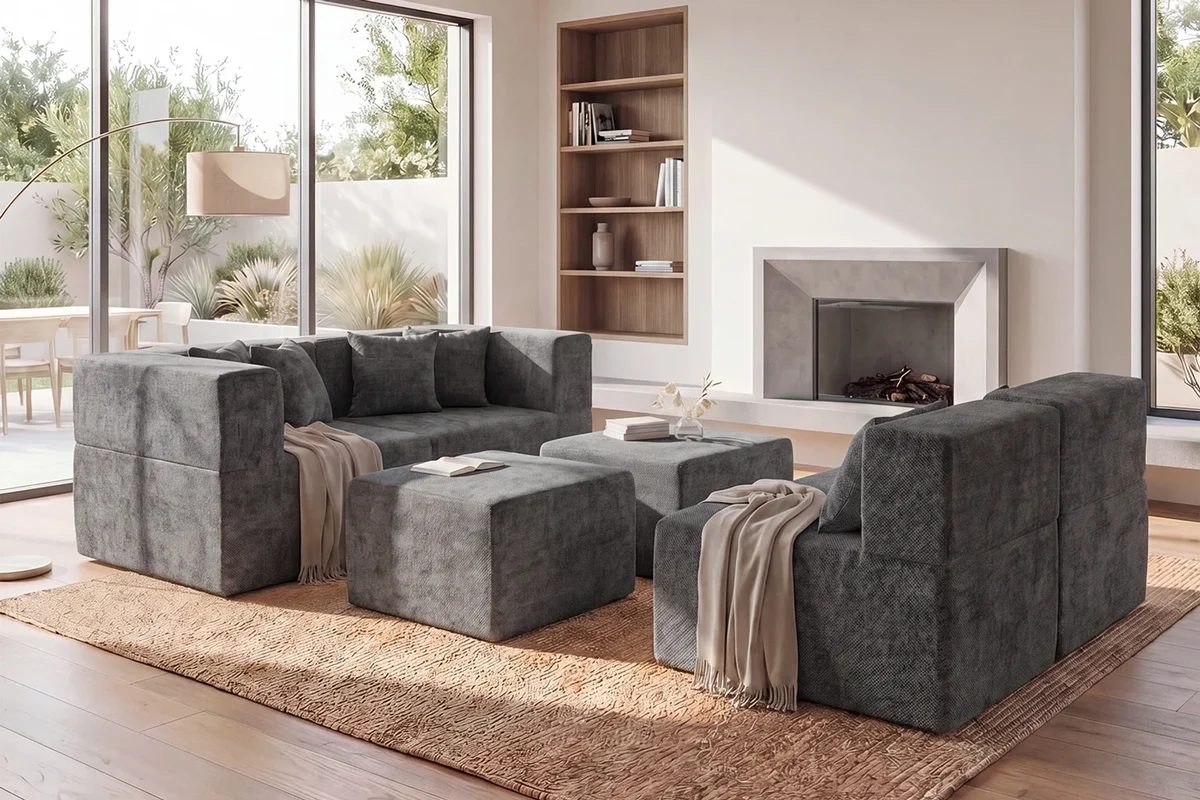
Choose a sectional if your household wants a connected place to stretch out and spend time together. Choose a sofa and loveseat if the smaller sofa has a useful position of its own—facing the main sofa, beside a window, or on another side of the room. The deciding question is whether you need continuous seating or two independently placed pieces.
Neither arrangement automatically saves space or seats more people comfortably. A sectional’s corner can be valuable lounging space without becoming another comfortable seat for a guest. A loveseat can create a welcoming conversation area, but only if it fits somewhere people actually want to sit.
Count the Seats People Will Actually Use
Imagine an ordinary evening with everyone at home. Assign each person a position, including anyone who likes to put their feet up. This reveals more than the number of cushions in a product photograph.
On a sectional, one person stretching across the corner may occupy space that could otherwise accommodate another sitter. A chaise provides leg support, but it does not necessarily add a separate place for someone else. Count the arrangement in the way your household will use it.
A sofa and loveseat divide the seating into two separate surfaces. That can work well when one person wants to recline on the main sofa while someone else reads on the loveseat. However, each piece still needs enough usable width for its intended occupants. Overall width includes the arms, so it should not be treated as sitting space.
For guests, think about posture as well as capacity. People who do not know one another well may appreciate separate seats or a little space between them. Family members watching a film together may actively prefer the connected feel of a sectional.
I would choose based on the positions used most evenings, then consider how occasional visitors could join them. Planning around the largest gathering of the year can leave you with furniture that overwhelms the room the rest of the time.
What a Sectional Gives You
A sectional is particularly appealing when lounging is central to how you use the room. Its joined sections can create a generous place to curl up, share a blanket, or sit close without an armrest interrupting the seating.
The configuration matters. An L shape can provide a lounging extension while leaving the opposite side open. A U shape adds another return, which may be useful when several people regularly want to spread out. The extra section earns its place when someone uses it; symmetry alone is not a strong reason to buy it.
When comparing Monvane’s L and U shaped sectional sofas, I would start by deciding what each projecting section needs to do. One might provide a regular reclining position. Another might add inward-facing seating. That makes it easier to choose a shape for its practical value rather than its size in a showroom image.
Pay attention to the distinction between a chaise and a return with seating along its length. They can create similar outlines on a floor plan while supporting different sitting directions. For a television-focused room, identify where each person will lean back and where their eyes will face.
When the Loveseat Earns Its Place
A sofa-and-loveseat arrangement becomes compelling when the loveseat improves the room in a way that an attached section would not.
For example, a loveseat facing the main sofa can give guests a natural place to talk. Along a shorter wall, it might provide a second seating position without extending the main sofa across an entrance. It can also become a quieter place to read while someone else uses the larger sofa.
Before choosing a loveseat sofa, I would identify that specific role. “It comes with the sofa” is less persuasive than “two people can sit here and face the people opposite them.”
The two pieces do not have to match exactly. Similar proportions or a shared color can connect them, while different upholstery adds variety. Seat height deserves attention, especially when the pieces face each other: a low, deeply cushioned loveseat and a much taller sofa may create a combination that feels less balanced in use than it looks in separate photographs.
Independent placement also creates a useful option later. The loveseat may move to another room while the main sofa stays. That is a practical advantage when you can already identify a plausible alternative location.
Compare the Whole Arrangement in the Same Room
Two separate pieces are not automatically compact. Each has its own arms and requires a usable position, while the gap between them may need to function as an entrance. A sectional can combine seating in one corner, but its return may extend into a route that needs to remain open.
Compare both complete arrangements on the same floor plan. Include the coffee table and the furniture you intend to keep. Do not give the sofa-and-loveseat option extra space by leaving out the table, or judge the sectional while assuming an existing cabinet will disappear.
Consider a room with an entry beside the proposed sofa position. A loveseat might leave a gap that makes the seating area easy to enter. But if placing it opposite the sofa leaves too little space between the two, that advantage disappears. A sectional with its return on the other side could work better.
This is where a simple floor outline helps. Mark the exact furniture footprints, then walk from the entrance to each intended seat. Check that doors and drawers still open and that someone seated does not have to move every time another person passes.
The useful comparison is between two workable plans. If one only succeeds after removing furniture you need every day, it is not yet a complete alternative.
Modular Sectionals Change the Flexibility Question
It is too broad to say that sectionals are fixed while separate sofas are flexible. Some modular sectionals support several arrangements, including straight or separated configurations. Their flexibility depends on the supplied pieces and how those pieces are designed to work.
Look for documented arrangements that would be useful in your home. A corner unit, an armless seat, and an ottoman have different roles. Being able to disconnect them does not necessarily mean each one works as a finished, independently supported seat.
A sofa and loveseat offer a simpler kind of flexibility: two complete pieces can be positioned separately. A modular sectional may offer more ways to change the seating shape. The better choice depends on which change you realistically expect to make.
If you anticipate moving, sketch one alternative arrangement using the same pieces. A plausible second layout is more convincing than a general promise that the furniture can adapt to anything.
Conclusion
For a household that spends most evenings lounging together, my first choice would be a moderately sized modular L-shaped sectional with one useful stretching-out position and an open side. I would resist adding a second return unless it solved a regular seating need.
I would choose a sofa and loveseat when the loveseat has a clearly better place away from the main sofa—especially opposite it for conversation. That is the distinction I would trust most: buy the connected arrangement when the connection improves comfort, and buy two pieces when their separation makes the room work better.