The cheapest tree removal quote I ever chased was $1,800. That same tree took out a wiring run and left an electric bill I am still annoyed about. The maple was already leaning over my neighbor’s driveway, and I nickel and dimed my way into a whole second round of problems.
Tree work draws a crowd of one-truck-and-a-sticker operators in Michigan, licensed and unlicensed alike, and telling them apart is not obvious from the curb. Here is how to figure out who is actually qualified, what you should expect to pay attention to, and why one property owner in Livonia can write a check with confidence while another watches a stump sink slowly into their lawn.
I am not going to hand you a magic price. I am going to hand you a way to think, so the next time a tree lands wrong, you know exactly what kind of crew you want standing in your yard.
Why does Michigan tree work get expensive so fast
Winter does a number on trees here, and you already know it. Ice on a limb does not just bend it, it breaks it, and the second half of the season is when the phone calls start. The other half of the problem is the federal and state view of Michigan’s woods, which are managed for fire risk and long term health rather than curb appeal.
The U.S. Forest Service publishes guidance on tree risk at the national level, and anyone working in your yard should be able to tell you what a hazard tree actually looks like rather than what it looks like in a brochure photo.
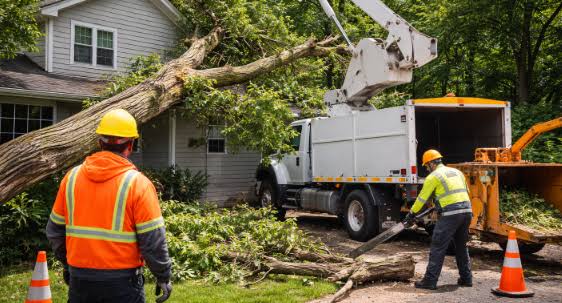
Industry bodies put tree care in the same class of work as utility and line clearance because a falling limb is a serious hazard. When someone shows up in a bucket truck and no hard hat, that is your signal, not your reassurance.
The Occupational Safety and Health Administration sets the standards employers are expected to follow, and a decent tree crew is not offended when you ask about their insurance certificate or whether their climbers have current training.
What a fair estimate actually covers
If you call three companies and get three numbers that feel vague, you are not imagining it. Tree removal quotes are built from a short list of things, and the good crews on the list will walk you through every one of them.
- How the tree comes down: straight felling, sectioning into the canopy, or a crane assisted lift over a structure.
- What happens to the wood: hauled off, processed into firewood, or left as rounds on the driveway for you to deal with.
- Whether the stump leaves with it, or stays and gets ground on a separate line item.
- Access: can a truck and chipper actually get to the tree, or do you have a fence, a shed, or a retaining wall in the way.
- Emergency pricing, and whether it changes after 5 p.m. or on a Sunday.
Notice what is not on that list. The species is barely a footnote. The size and the risk are the numbers that move a quote. A forty foot oak standing in the middle of a clear yard is not the same job as a forty foot oak leaning over a garage, and a company that quotes both the same way has not looked at the actual site.
The two questions that separate real tree services
Ask a crew what happens if the limb lands on your roof. Their answer tells you more than the quote does. A real outfit carries liability coverage and can put a certificate in your hand, and it offers emergency storm response with a stated response window. The other answer, the shrug and the “we’ll work it out,” is not a plan.
The second question is who is doing the climbing. If the person who measured the job is the same person who straps on the saddle and goes up, you are talking to a small outfit that knows its own limits. That is not automatically bad. Twenty years of local work in the Detroit Metro area counts for something a national chain with a call center cannot fake, especially when you need someone who understands Southeast Michigan’s soil, wind patterns, and tree species.
That little combination, local reputation plus the willingness to pull out paperwork, is exactly what I look for now. I have seen it very pleasantly present in a lot of Full-Service Tree and Landscaping Solutions in Michigan, the kind that handles the felling, the cleanup, and the re-planting in one visit instead of leaving you tracking down three separate contractors.
A ten minute walkaround before you commit
Do this yourself, before the estimator arrives, so you are comparing apples to apples.
- Walk the property line. Note every tree that shades the roof, the driveway, or a utility drop.
- Check the trunk. Mushrooms at the base, cracks, or hollow spots mean the tree is already a liability.
- Photograph anything leaning. A tilted trunk near a structure is the single fastest reason to call.
- Mark your underground lines. Michigan’s free utility locating service exists for exactly this.
- Write down what you want gone and what you want kept. A crew cannot thin for light if you never said you wanted shade.
Bring that list to the estimate. The estimator who reads it slowly and asks follow up questions is the one you want. The one who waves it off and quotes a number from the truck has just told you everything.
Landscaping is a different job, so treat it like one
Removing a tree and redesigning a yard are two skills that live in different parts of the same brain. The Bureau of Labor Statistics tracks grounds maintenance and landscaping as a distinct occupational group from construction and extraction trades, and that split shows up on your invoice. Tree removal is short, loud, and heavy. Landscape installation moves soil, plants, and hardscape, and it takes weeks, not hours.
So ask whether a company does both or subcontracts the second half. If the answer is both, ask who supervises each phase. A crew that grinds a stump and then installs a bed around the disturbed soil needs a plan for the mess, because fresh grindings will sink as they decompose and your new plantings will ride down with them. I have watched a beautiful bed of hostas slide downhill for an entire season because nobody told the homeowner to fill the stump hole first.
What the bill should look like
| Line item | What you should see | Red flag
|
|---|---|---|
| Removal | Method, tree count, access notes | “Tree work, one price” |
| Stump | Depth ground and root flare addressed | Grinding sold as “including stump” |
| Haul away | Where the debris goes | Left at the curb with no note |
| Cleanup | Blow and rake, listed | Missing entirely |
| Emergency | Stated rate and call number | No written storm policy |
Get all of that in writing, and get the insurance certificate emailed to you before any saw starts. Not a photocopy. An email, dated, with your address on it.
The rule I follow now
If the first quote is dramatically lower than the other two, it is not a bargain. It is a warning about what got left out of the scope. The mid range quote that includes hauling, stump work, and cleanup is usually the honest number, and it is the one I sign. If you get a single crazy low bid and take it anyway, you will pay the difference on the second visit, and possibly the third.
So here is what I want you to do this week. Walk your yard. Make the list. Call two or three
licensed, insured crews, and ask them the two questions about liability and who climbs. When the storm does hit, you will already know who to dial, and that is worth more than the $300 you saved chasing the cheap guy.
What is the oldest tree on your property, and has anyone actually looked at its trunk this year?