Live sports remain one of the few things people still watch together in real time, which is why media companies keep paying more for them. But how fans watch, and who pays for it, has changed quickly. This article looks at the forces reshaping the business.
Sports media revenue is also lifted in some years by cyclical mega-events, such as the expanded 2026 World Cup in North America and the Winter Olympics, which can make market totals look healthier than the everyday business underneath them.
The cable subsidy is fading
For decades, networks paid for sports rights by bundling channels into cable packages that every subscriber paid for, whether or not they watched. As millions of households cancelled pay TV, that subsidy weakened. Regional sports networks felt it first. Diamond Sports Group, owner of the Bally Sports channels, filed for bankruptcy in 2023 with debt reported at between $8 billion and $9 billion depending on the source, and its restructuring left several teams searching for new ways to reach fans.
Teams and leagues now mix local over-the-air broadcasts with direct-to-consumer streaming. Keeping a streaming subscriber month after month costs more than collecting a cable carriage fee did, and the economics are still being worked out.
Technology companies change the bidding
Amazon, Apple and other technology companies value sports differently from traditional broadcasters. A network depends on advertising and carriage fees, while a tech company can treat live games as a way to attract subscribers and sell other services. That gives these companies room to bid. The NBA’s current deals with Disney, NBCUniversal and Amazon, reported at about $76 billion over 11 years starting in 2025-26, show how much has shifted.
The tradeoff for fans is fragmentation. A single season of games can now be split across broadcast, cable and several streaming services, and the total cost of following one team across all of them can add up. Treat any specific per-fan price as an estimate, since it depends on the team and the plans chosen.
The second screen
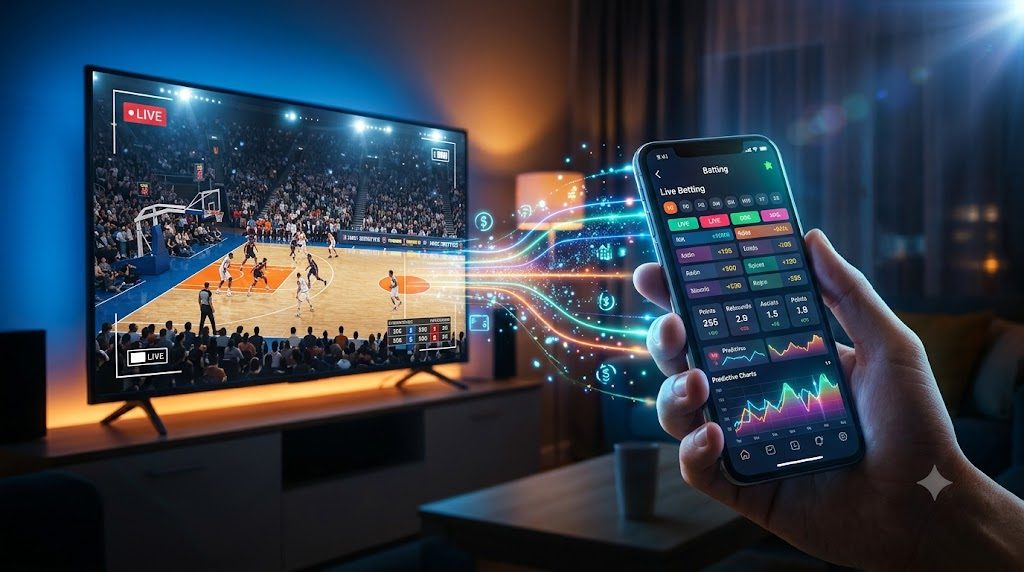
Most live sports have natural pauses: timeouts, replays, commercial breaks. Surveys regularly find that a large share of viewers use a phone or tablet while watching, and many use it for information related to the game, such as stats, social media and fantasy scores. For advertisers, a viewer looking at a phone during a commercial is a problem. For sports companies, it is an opportunity to offer something useful on the other screen.
Betting and in-game engagement
One response has been interactive products tied to the game, including fantasy, free-to-play prediction games and, where legal, sports betting. Sportsbook apps such as DraftKings publish live NBA odds and player props that update through a game, which gives viewers a reason to follow individual players even when the score is lopsided.
That is a business model with real risks as well as appeal, and operators are required to offer responsible-gambling tools in regulated markets. Fans who use these products should set limits, treat any wager as entertainment spending, and stop if it stops being fun.
The technology behind live data
Betting on live events raises a technical problem. Standard video streaming can run tens of seconds behind the action, and a bettor who sees the play before the odds update has an edge. Operators address this with faster video delivery, with data feeds that are independent of video, and by suspending markets when something happens on the court. Lower-latency streaming protocols such as WebRTC are used in some products, but the specific delay a given service achieves varies and operators do not generally publish it.
Integrity is the weak point
The more granular the market, the greater the integrity risk. A single player can affect a prop bet without affecting the final score. The best-known recent case is former Toronto Raptors player Jontay Porter, who was banned from the NBA for life in April 2024 after the league found he had shared confidential information with bettors and wagered on NBA games, and who later pleaded guilty to wire fraud conspiracy. Reporting at the time said an $80,000 bet that would have paid $1.1 million was flagged and not paid out.
Since then, leagues, regulators and the NCAA have pushed to limit or ban certain player-prop markets, particularly on college athletes, and several states have acted. Integrity monitoring and cooperation between sportsbooks and leagues are now a standard part of how licensed operators work.
What to expect
The next few years of sports media will likely include more streaming exclusives, more bundling to ease fan costs, and more attention to player protection in betting markets. Whether fans stay loyal depends on whether the game, and the way they follow it, stays worth the price.
Sports betting is for adults 21 and over where legal. If gambling is a problem for you or someone you know, call 1-800-GAMBLER.