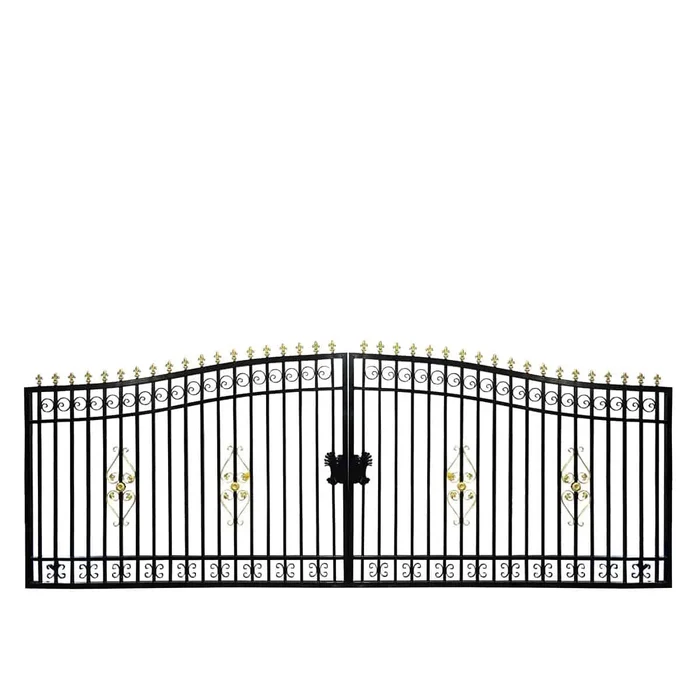
A fence package quoted in linear feet looks like a simple purchase: measure the perimeter, order that many feet, install. The number on the tape and the number the site actually consumes are rarely the same, and the difference turns up on installation day when there is nothing left for the last run. Wrought iron fence panels come in fixed lengths, and fixed lengths do not stretch.
Panels are rigid and the ground is not
Ornamental fence panels arrive as complete units with finished end pickets. Cutting one to fit removes that finished end and leaves cut pickets that have to be capped, which is possible and never looks like the rest of the fence.
The consequence is that a run divides into whole panels or it does not. A ninety foot run made of eight foot panels is eleven panels and two feet left over, and that two feet has to go somewhere a visitor is not looking.
Corners and gate openings consume feet
Every corner post interrupts a run and starts a new one, so a rectangular yard is four separate runs rather than one perimeter. Each of those runs has its own leftover. A gate opening removes its own width from the fencing and adds two posts that are not part of the panel count. A ten foot opening in a hundred foot run leaves ninety feet of fencing, and almost nobody orders it that way the first time.
Slope turns a rectangle into stepped panels
Ground that falls across a run has to be handled by racking the panel into a parallelogram or by stepping level panels down in increments. Racking works to a limit that the manufacturer specifies, usually expressed as a rise over the panel length.
Stepping handles steeper ground and leaves a triangular gap under each panel. On a boundary that has to contain a dog those gaps need filling, and the filling is a separate material and a separate decision.
Fence post spacing follows the panel
Posts go where fence panels end, and nowhere else. That sounds obvious and it is routinely got wrong, because people set posts at an even spacing taken off a drawing first, and then discover on the day that the panels do not reach between them.
Three measurements settle the order:
• Total run length between fixed points
• Number and width of gate openings
• Worst grade change across any single run
The third is the one that gets estimated by eye. A grade that looks gentle across a long yard can exceed the racking limit over a single panel length, and that is only discovered when the panel will not sit square.
Metal fence and the ground that holds it
Posts resist wind on the panels and keep the line straight, and in a frost climate they also have to resist being lifted. Footing depth below the frost line matters as much on a fence run as it does on a gate, even though the loads are smaller.
Granular backfill drains and clay holds water. A post surrounded by material that freezes around it gets gripped and lifted, and a line of posts that have each lifted a different amount is a fence that no longer looks straight from the road.
What a package includes and what it does not
A linear foot package typically covers panels, posts, hardware and the gate if one is specified. Concrete, gravel, post caps on some ranges and anything to close a stepped gap are generally not in the box.
Reading the inclusion list before ordering avoids a second trip. It also avoids the more expensive version, which is discovering mid installation that the hardware supplied suits a flat run and the yard is not flat.
Finish is a maintenance decision made at purchase
Galvanized and then powder coated is the normal specification on an iron fence, and the coating does the corrosion work while the galvanizing is the backstop when the coating is damaged. Damage happens at ground level, where a trimmer line strikes the pickets. That is worth knowing because the repair is a touch up on the day rather than a rusted picket two years later, and it is the one maintenance task these fences actually need.
Reading the package past the footage
On a package of fence panels, linear feet, panel height and picket spacing are what get compared. Panel length, racking capability, post dimensions and what the hardware assumes about grade describe whether the package fits the yard it was bought for.
TMG Industrial supplies this one as a 110 linear foot package with a bi parting gate included. Measuring each run separately, subtracting the openings and checking the grade against the racking limit, is the half hour that prevents a short order.