
Validating SAP Joule Agents: What Changes for Your Test Strategy
SAP now ships more than 40 specialized AI agents and over 2,400 Joule Skills across S/4HANA, SuccessFactors, Concur, Ariba and the Business Technology Platform. Joule Studio on SAP Build lets teams create their own agents that operate inside transactional workflows.
Most of the discussion so far has been about what these agents do. There has been noticeably less about how you validate them, and that gap matters more than it first appears, because the testing approaches most SAP organisations have built over the last decade assume something that is no longer true.
They assume determinism. Same input, same path, same output. That assumption underpins eCATT scripts, recorded regression suites, and the whole practice of validating a transaction by replaying it. Joule agents do not behave that way, and the difference is not a matter of degree.
It is worth being precise about what changed, because “automation” covers both and the distinction is easy to lose.
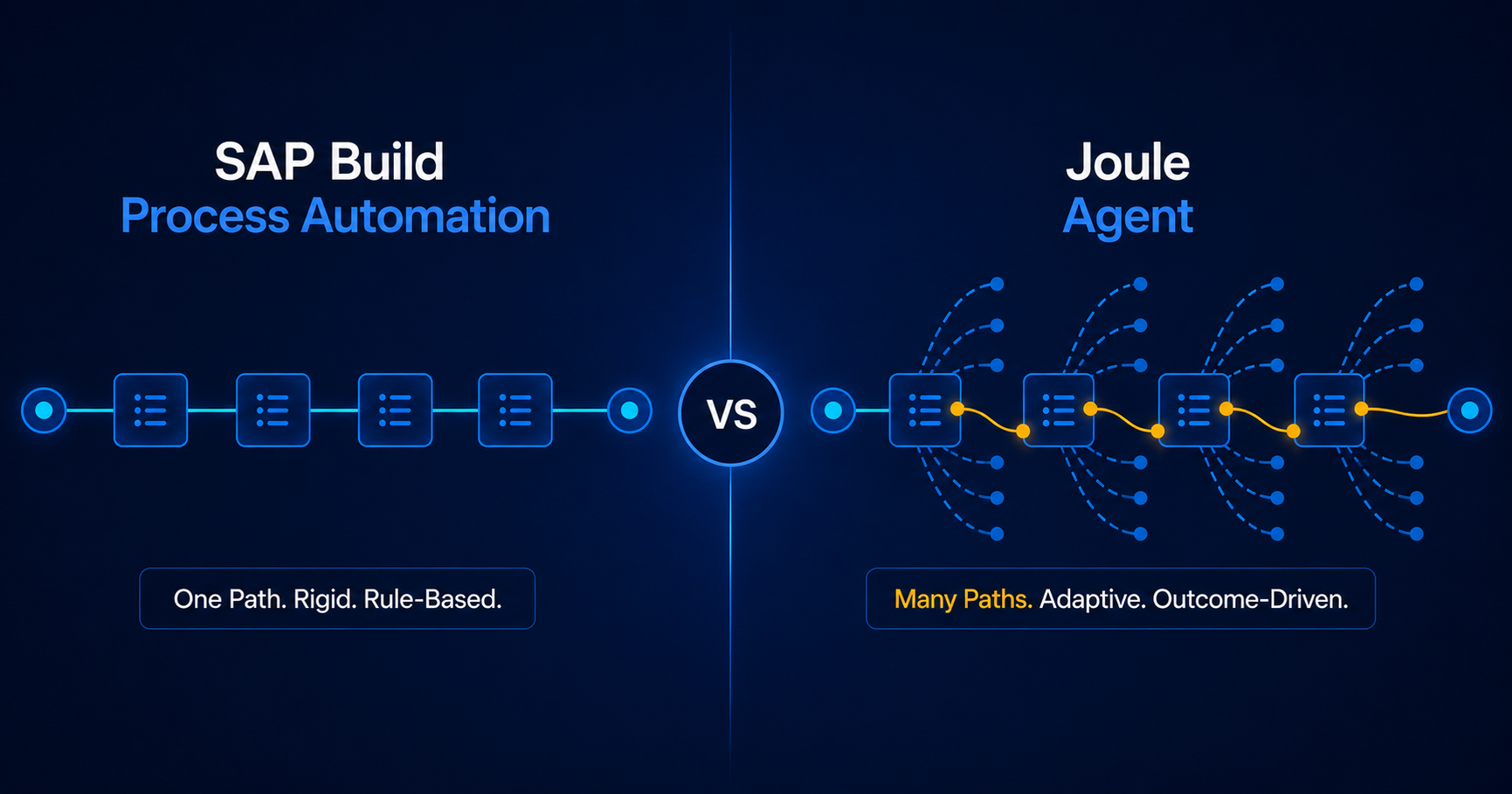
SAP Build Process Automation, and SAP Intelligent RPA before it, executes a defined sequence. You record or configure the steps, the bot performs them, and if the interface changes the bot breaks. Frustrating, but predictable, and predictability is what makes it testable: you validate that the recorded path produces the expected result.
A Joule agent reasons about context and decides. Given an incoming document, it interprets what it contains, determines what action is appropriate, and executes, potentially taking a different route on Tuesday than it took on Monday, because the context differed. That is the capability you are buying. It is also what invalidates replay-based validation.
| Dimension | SAP Build Process Automation / iRPA | Joule Agentic AI |
| Decision model | Rules-based, configured conditions | Probabilistic, inferred from context |
| Execution path | Fixed, recorded or defined | Dynamic, determined at runtime |
| Response to change | Breaks, visibly | Adapts, possibly silently |
| Scope boundary | Explicit, limited to configured steps | Implicit, agent may infer adjacent actions |
| Testability | Replay the path, assert the result | Requires outcome and behaviour validation |
| An RPA bot is a macro with guardrails. A Joule agent is a colleague with judgement. You do not test a colleague the same way you test a macro. |
Three Failure Modes Your Current Testing Will Not Catch
Traditional SAP testing reliably catches two categories: system failures where a transaction errors or a posting fails, and configuration failures where an account assignment or approval route is wrong. Both are deterministic, reproduce the input, and reproduce the failure.
Agents introduce three categories that behave differently.
1. Decision quality drift
An agent classifying vendor invoices correctly 94% of the time in March may be at 87% in September, because its model updated, its context shifted, or a dependent configuration changed. No document errors. The postings succeed, financial dimensions resolve, and every individual transaction looks defensible on inspection.
At the population level, though, decision quality has degraded, and nothing in a transaction-level test will surface it. In SAP the exposure concentrates in exactly the places you would expect: automatic account determination, tax code assignment, intercompany pricing, and credit management, where small systematic errors compound across thousands of documents before anyone notices.
Detecting this requires monitoring decision distributions over time against a validated baseline, which is a fundamentally different activity from testing a transaction.
2. Scope creep through inference
An agent configured to handle routine purchase requisitions may, through context inference, begin acting on requisitions outside its intended scope, higher values, different material groups, or plants it was not designed to serve. It is not malfunctioning. Every transaction it posts is valid SAP activity. It is simply operating somewhere it should not be.
This is the failure mode traditional test scripts structurally cannot catch, because scripts validate what the agent does, not what it should refrain from doing. Catching it requires negative testing: deliberately presenting out-of-scope scenarios and confirming the agent refuses or escalates rather than proceeding.
3. Compliance evidence gaps
When an AP clerk posts an invoice, the trail is comprehensive, user ID, timestamp, change documents, approval workflow. When a Joule agent posts the same invoice, the chain can have gaps. Why did it select that G/L account? Why that approver? Why those payment terms? That reasoning may not be captured in a form an external auditor can evaluate.
This stopped being theoretical in 2026. EU AI Act obligations for high-risk systems became fully enforceable in August, and in March the SEC announced a dedicated SOX enforcement group targeting ICFR failures. For SAP specifically, where the system is the financial record, absent agent-level evidence is a control deficiency waiting to be identified.
Why SAP GRC Does Not Cover This
This is the part most worth flagging to anyone running SAP Access Control, because the gap is structural rather than a configuration oversight.
SAP’s authorization concept is role-based and designed for human users: roles carry authorization objects, users are assigned roles, and segregation of duties is analyzed across user assignments. It works well, and it has been refined over decades.
Agents operate through service accounts and API credentials. Those identities frequently sit outside the access recertification cycle applied to named users, and, more consequentially, SoD analysis may not flag agent-level conflicts at all, because the agent is not a “user” in the sense the ruleset was built around. An agent can therefore hold a combination of authorizations that would be flagged immediately if a person held them.
| Your SoD ruleset was written for people. The agent posting to your ledger is not one, and your GRC tooling may not have noticed. |
Testing has to fill that gap: validating that agents operate within their intended boundaries even where the authorization framework technically permits more, and evidencing that validation for audit.
A Reference Approach for Validating SAP Agents
Five layers, working from the failure modes above. This is deliberately tool-agnostic, it describes what needs validating rather than what to buy.
| Layer | Validates | SAP-Specific Scope |
| 1. Decision | The agent produced a correct business outcome | Postings in BKPF/BSEG, purchasing in EKKO/EKPO, sales in VBAK/VBAP; cost centre and profit centre assignment; period correctness |
| 2. Scope | The agent stayed inside its authorized boundary | Authorization objects, org-level restrictions, value thresholds; negative testing against out-of-scope scenarios |
| 3. Drift | Behavior remains consistent with the validated baseline | Account determination distribution, approval routing patterns, classification consistency over time |
| 4. Audit | Every action produces evidence an auditor can evaluate | Change documents, table logs, agent identity and version, decision rationale, rule basis |
| 5. Regression | All layers re-validated after every change event | Support packs, feature packs, Fiori library updates, Joule model version changes |
Layer 5 deserves emphasis in an SAP context specifically. Between quarterly support packs, feature pack releases and continuous Joule model updates, an S/4HANA environment running agents is never static for long. Periodic validation, monthly, quarterly, leaves windows in which agent behavior can shift with nothing checking. The cadence has to match the change cadence.
Where This Sits Alongside Your Existing Test Strategy
Worth being clear that this is an additional layer, not a replacement for anything you already run.
SAP Cloud ALM covers test management and process orchestration. Functional regression tooling, whether that is Tricentis, Worksoft, or something built in-house, validates that the system behaves correctly when exercised. Unit and integration frameworks validate ABAP and BTP code. SAP GRC governs authorizations. All of that remains necessary and none of it is displaced by anything in this article.
What none of those layers was designed to cover is continuous validation of whether an autonomous agent is making correct decisions, staying within scope, and generating audit-grade evidence while doing it. That is the gap, and it is new enough that most organizations have not yet assigned it an owner.
How Sofy Approaches SAP Agent Validation
This is where I should be transparent about affiliation: I work with Sofy.ai, and this is the problem our SAP Test Agents were built for.
Sofy SAP test agents deploys module-specific agents, FI/CO, MM, SD, HCM, and SuccessFactors and Concur, which validate SAP business outcomes at the data layer rather than at the Fiori UI layer. In practice that means asserting that a document posted to the correct G/L account and period that financial dimensions resolved as configured that sub-ledger reconciles to the general ledger, and that a purchase order routed according to the delegation matrix.
Mapping to the five layers above: decision validation runs against the underlying document tables rather than screen state; scope validation includes negative testing against out-of-scope scenarios; drift monitoring establishes a behavioral baseline and tracks decision distributions against it; every validation produces a timestamped, immutable record suitable for SOX evidence; and because agents understand SAP module logic rather than screen structure, coverage adapts through support pack cycles rather than requiring rework after each one.
It sits alongside SAP Cloud ALM and whatever functional regression tooling you already run, rather than replacing them. Further detail is at
Where to Start
If Joule agents are operating in your landscape, or about to be, three things are worth doing before the validation question becomes an audit question:
- Inventory what is actually running. Most organizations find agents embedded in modules they did not separately provision. You cannot validate what you have not catalogued, and vendor release cycles add capability without customer action.
- Establish behavioral baselines early. Drift detection is only possible against a recorded baseline. Capturing the expected distribution of agent decisions at deployment costs little; reconstructing it after six months of drift is not really possible.
- Decide who owns agent validation. In most SAP organizations this currently sits between the CoE, internal audit and QA, which in practice means nobody. Naming an owner is the cheapest risk reduction available.
SAP has moved quickly on agentic capability, and the functionality is genuinely useful. The validation practice around it is simply younger than the technology, which is a normal and temporary state. The organizations that close the gap early will be the ones able to answer their auditor’s questions without a scramble, and, more usefully, the ones that can expand agent adoption with some confidence about what the agents are actually doing