
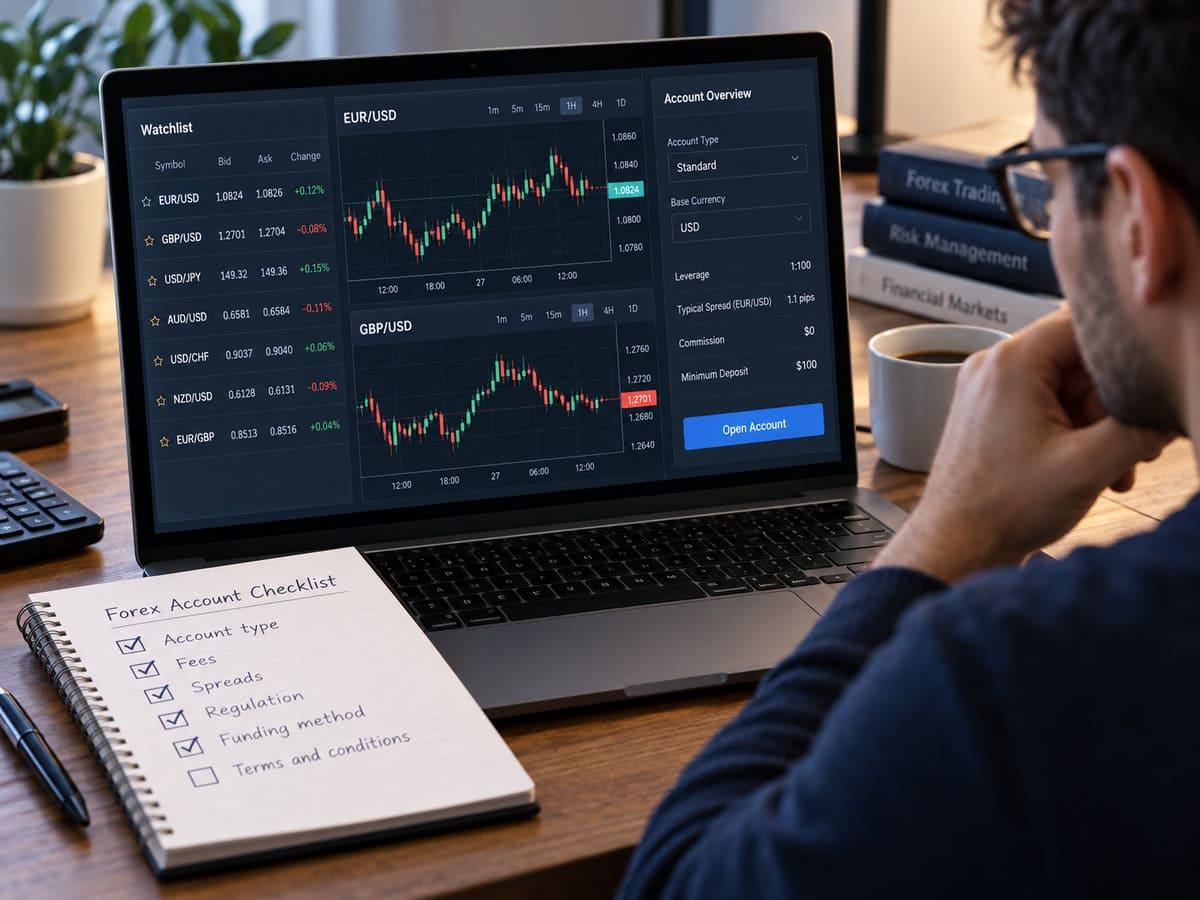
Before funding a forex account, check regulation, trading costs, margin, withdrawal rules, platform features and bonus conditions.
Opening a forex trading account is relatively straightforward. Deciding whether you should put money into that account deserves more attention.
A broker's website may show spreads, platforms and promotions prominently, but those are only part of the picture. Before making a first deposit, it is worth checking who regulates the broker, what trading actually costs, how margin works and what happens when you want to withdraw your money.
A few checks before funding an account can tell you much more than the size of a welcome offer.
1. Check Who Regulates the Broker
Regulation is a sensible place to start because forex requirements differ between countries.
For traders in the United States, firms offering retail off-exchange forex generally need to meet specific regulatory requirements. The Commodity Futures Trading Commission (CFTC) advises customers to check whether a forex dealer is registered and to review its disciplinary history before making an initial deposit.
The National Futures Association's BASIC database can also be used to look up registration and background information.
Do not rely only on a statement saying a broker is "regulated." Check which legal entity operates the account, which regulator oversees it and whether those details match the information in the regulator's records.
This becomes especially important when comparing an offshore provider with one registered to serve customers in your country. Similar-looking websites do not necessarily provide the same protections or operate under the same rules.
2. Know What Trading Will Actually Cost
The advertised spread is often the first cost traders notice, but it may not be the only one.
Depending on the account and broker, trading costs can include spreads, commissions and financing charges for positions held overnight. There may also be conditions or charges associated with deposits, withdrawals or currency conversion.
Consider a trader who frequently opens and closes relatively small positions. Even a modest difference in transaction costs can become significant after dozens of trades.
That does not mean the account with the lowest advertised spread is automatically the cheapest. Compare the overall pricing structure with the way you expect to trade.
It is also worth checking whether spreads are fixed or variable and whether they can widen during periods of lower liquidity or significant market news.
3. Understand Margin Before Thinking About Position Size
Margin allows traders to control a position larger than the amount of money committed to that trade. That makes leverage one of the most important features of forex trading to understand before depositing money.
Suppose a position has a 2% margin requirement. A $2,000 margin amount could be used to open a position with a notional value of $100,000.
The larger position creates greater exposure to movements in the exchange rate. That works in both directions. Leverage can amplify gains, but it also amplifies losses.
The CFTC warns that retail forex traders can lose all the funds deposited for trading and may, depending on the circumstances, be liable for losses beyond the initial deposit.
This is why the maximum position available through an account should not be confused with an appropriate position size. Before funding an account, understand its margin requirements, when positions may be closed because of insufficient margin and what additional losses you could face.
4. Read Trading Bonuses as Account Terms
Promotions can make one account look more attractive than another, particularly when someone is opening a forex account for the first time.
The useful question is not simply, "How big is the bonus?"
It is, "What conditions come with it?"
Forex promotions can be structured in different ways. Some no-deposit forex bonuses provide promotional credit without requiring the customer to fund the account first. Others only become available after an initial deposit has been made.
A welcome deposit bonus, for example, may add trading credit after a new customer funds an eligible account.
Those two arrangements are not the same, even if both are described using the word "bonus."
Before accepting any promotion, check who qualifies, whether a minimum deposit is required, how the credit can be used and whether the promotional amount itself can be withdrawn. Also check whether there are restrictions connected with profits, withdrawals or account activity.
A bonus can change the amount of trading credit available in an account. It does not change the underlying risk of the trade.
5. Check the Withdrawal Rules Before You Deposit
Depositing money tends to receive more attention than withdrawing it. It should probably be the other way around.
Before funding an account, look at the withdrawal process. Check which payment methods can be used, whether funds normally need to be returned through the original funding method and whether identification or account verification must be completed first.
You should also check for withdrawal charges and processing conditions.
The CFTC specifically advises forex customers to review account funding and withdrawal requirements before opening an account. It also warns that demands for additional payments simply to release a customer's own funds can be a sign of fraud.
Withdrawal rules should be available before you deposit. You should not have to discover important conditions only when you decide that you want your money back.
6. Spend Some Time With the Trading Platform
An account can look competitive on paper and still be awkward to use.
Before making a significant deposit, become familiar with the platform's basic functions. That includes placing an order, setting stop-loss and take-profit levels, reviewing margin information and closing a position.
Check how clearly the platform shows open positions, unrealized profit or loss and available margin.
A demo account can be useful for learning where these functions are located without putting money at risk. However, demo trading should not be treated as evidence that the same strategy will produce profits in a live account. Real money changes both execution conditions and, quite often, trader behavior.
Mobile access may matter as well, particularly if you expect to monitor positions away from a computer. The important point is not how many features a platform has, but whether you understand how to use the ones that affect your trades.
7. Decide How Much You Can Afford to Put at Risk
A broker may set a minimum deposit, but that number does not tell you how much you should deposit.
The decision should start with your own finances.
Money used for leveraged forex trading should not be needed for rent, debt repayments, emergency savings or other essential expenses. A smaller account can limit the amount of money at risk, although it can also restrict position sizing and margin flexibility.
Equally, depositing more money does not make a risky strategy safer by itself.
Think about the amount you could lose without affecting your regular financial obligations. Then consider whether the position sizes you plan to trade make sense within that amount.
If those two numbers do not fit together, increasing the deposit is not necessarily the answer. Reducing the planned exposure may be the more useful place to start.
Start With the Account, Not the Promotion
A promotion, tight spread or polished trading platform can attract attention, but none of them should replace the basic checks that come before funding an account.
Find out who regulates the broker. Understand its costs, margin requirements and withdrawal process. Read promotional conditions rather than stopping at the headline offer, and make sure you know how the trading platform works before putting significant money behind a position.
Forex trading involves substantial risk, particularly when leverage is involved. A first deposit should therefore be the end of the account-checking process, not the beginning.