
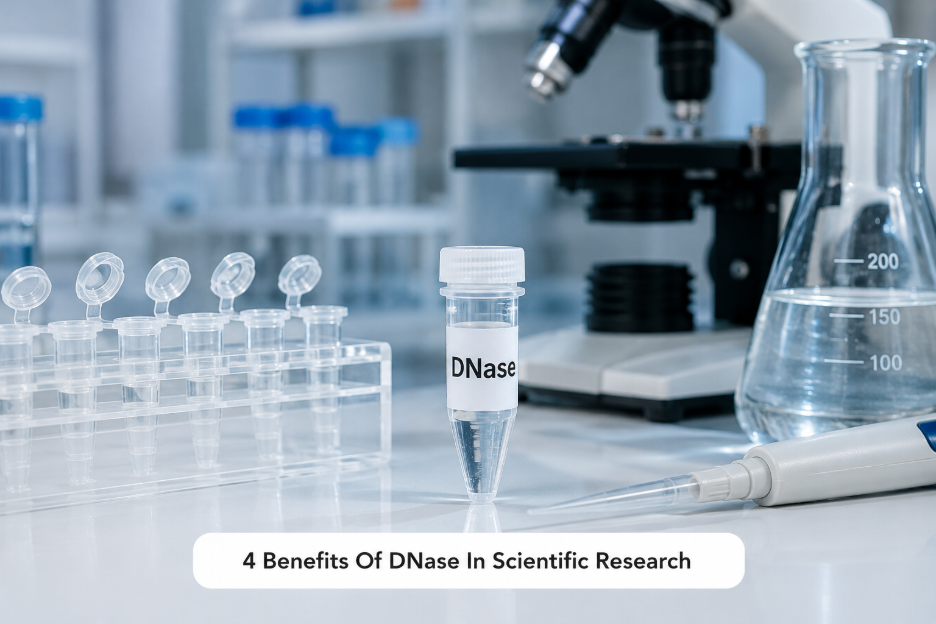
Imagine spending weeks designing an experiment only to discover that hidden DNA contamination has affected your results. Just a little extra unwanted DNA can alter the result of important research. That’s why scientists use specialized tools to maintain the cleanliness of their samples and ensure the highest possible accuracy.
One of the most useful is DNase, an enzyme that, by itself, does not harm other crucial molecules but can degrade unwanted DNA—a crucial role in molecular biology, biotechnology, medical research, and other areas of science.
In this article, we will review 4 benefits of DNase in scientific research and why the DNase enzyme has become so vital to modern laboratory research.
1. DNase Improves Sample Purity
One of the greatest benefits of using DNase is its ability to remove unwanted DNA from biological samples. In experiments, residual DNA can contaminate RNA experiments, protein analyses, and other lab work. Without its removal, researchers can find themselves with inaccurate results or conclusions.
Scientists who are studying gene expression will, for example, isolate RNA from cells. A little contaminating DNA can make a big difference in the end. However, DNase can digest away any unwanted DNA from the sample, while retaining the RNA. This will make the sample cleaner and increase confidence in the findings.
High-quality sample preparation also saves valuable time. Researchers do not need to expend as much effort to repeat experiments because contamination levels are minimized from the outset. This results in improved laboratory productivity and effective management of research resources.
Further, when using purified samples, collaboration between research teams is enhanced. The more similar the purification process is, the more consistent the results expected from laboratories around the world. This uniformity is crucial for furthering scientific research and confirming findings.
2. It Increases Accuracy In Molecular Biology Experiments
In many molecular biology techniques, highly accurate results are necessary. Polymerase chain reaction (PCR) and reverse transcription polymerase chain reaction (RT-PCR) require samples free of unwanted DNA contamination. RNA sequencing also relies on samples free of unwanted DNA contamination.
DNase has an important function only to analyze the intended genetic material. This reduces the risk of false signals (false positives), which could lead to inaccurate conclusions.
DNA contamination can cause false reads in RNA measurements used to interpret gene responses to disease or treatment. This is a problem that can be solved by DNase treatment, which removes this problem and does not interfere with the experiment; rather, it reflects the true activity of the RNA without contamination from residual DNA.
The higher the accuracy, the more reliable the published research will be. Scientific research frequently is based on previous research. In addition, contamination in early stages can affect future research. By employing DNase, you can better establish a solid foundation of scientific knowledge with reliable data.
In medical research, accurate results are particularly useful, as they can help develop a new diagnostic or treatment based on laboratory findings. Reliable experiments aid researchers in making decisions throughout their research process.
3. It Supports Biotechnology And Pharmaceutical Development
Clean and reliable laboratory procedures are crucial for modern biotechnology. Many production and research processes have come to rely on DNase in the biotechnology and pharmaceutical industries.
In the production of biological products, such as vaccines and therapeutic proteins, residual DNA is often a source of contamination for scientists. Finished products often need to contain very low amounts of host-cell DNA, for regulatory reasons. By removing unwanted genetic material during purification, DNase helps meet these quality requirements.
The enzyme is also useful for research with cell cultures, recombinant proteins, and gene technology. It cleanses biological materials, making downstream processing easier and improving the quality of the experimental results.
The other benefit is increased manufacturing efficiency. Early removal of unwanted DNA during manufacture can help alleviate contamination risks in later processes and ease purification. This ensures uniformity in the company’s products and reduces waste.
With advances in biotechnology, researchers require reliable lab instruments to drive innovation without sacrificing quality. One of the enzymes trusted by scientists to develop safer and more effective biological products is DNase.
4. It Helps Produce Reproducible Research Results
Reproducibility is one of the most important principles in science. Results obtained in an experiment should be repeatable under similar conditions. However, researchers may doubt the validity of the original results if they can’t replicate them.
DNase helps to make experiments reproducible by eliminating one of the most important sources of experimental variation. Not all samples may be equally susceptible to DNA contamination. Different samples might have more contaminating DNA than others, resulting in variability. DNase treatment of samples helps to standardize sample preparation and minimizes this source of error.
Standardization of sample preparation also benefits large research projects involving several laboratories. Similar protocols are followed by teams working in various locations, and they obtain comparable data. This is especially useful in international partnerships, clinical research, and research programs over extended periods.
Reliable results also enhance the efficiency of science. Researchers spend less time struggling with contamination issues and more time on meaningful data. When experiments yield consistent and reproducible results, they provide advantages to funding agencies, academic institutions, and industry partners.
With the increasing data-driven nature of research, reproducibility is gaining increasing attention. DNase supports this goal by helping researchers maintain the high standards of their laboratory from the start of each experiment.
Conclusion
The usefulness of DNase has grown in many areas of scientific research, as it addresses one of the most common lab challenges: unwanted DNA contamination. This enzyme is used to obtain purer samples, conduct more accurate experiments, support the development of biotechnology, and enable the repetition of experiments to yield more reliable scientific discoveries.
Today, DNase continues to contribute to research and innovation in academic laboratories and pharmaceutical production plants. Given advances in science, the use of scientific tools such as DNase will remain crucial for generating reliable results trusted by research and healthcare professionals.