
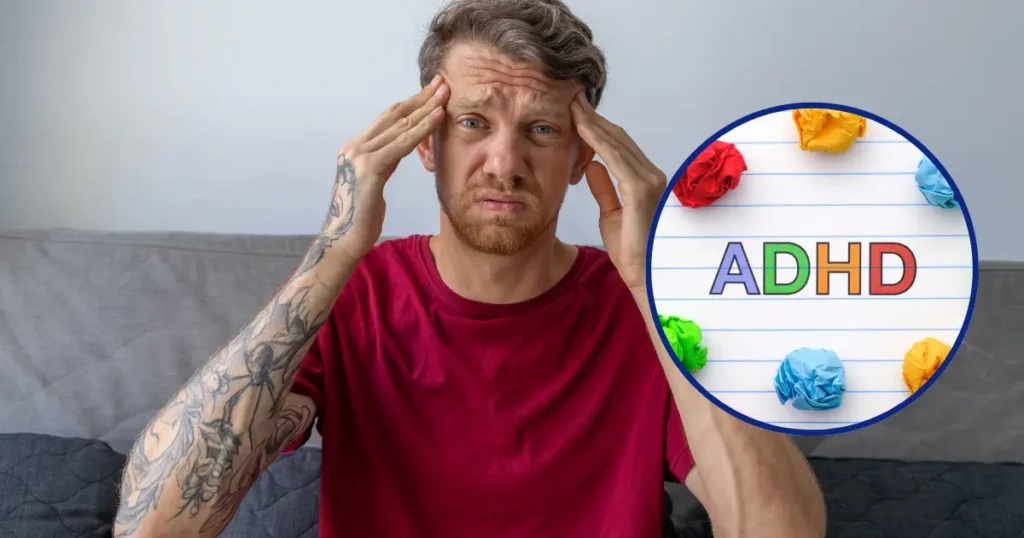
Most adults who finally learn they have ADHD do not find out because they were bouncing off the walls. They find out because a child gets diagnosed and the description sounds uncomfortably familiar, or because the fourth planner of the year is abandoned by February, or because a therapist asks one question nobody asked before. The counselling team at Curio Counselling in Calgary’s Beltline sees this pattern weekly: capable, hard-working adults who have spent decades assuming they were lazy, disorganized, or simply not trying hard enough. They were not. Adult ADHD is a neurodevelopmental difference in how the brain manages attention, time, and self-regulation, and CADDRA, the Canadian ADHD Resource Alliance, estimates it affects roughly 4 to 6 percent of Canadian adults. Most of them were never identified as children.
This article covers the seven signs that are most often missed in adults, why women in particular are diagnosed late, who can actually diagnose ADHD in Alberta, and where counselling fits beside medication.
Why adult ADHD looks nothing like the stereotype
The childhood picture of ADHD is a restless boy who cannot sit still. Adults rarely look like that. Physical hyperactivity usually turns inward by the late teens and becomes a mind that will not slow down: chronic restlessness, a habit of filling every quiet moment, three browser windows and a podcast running at once. The inattentive presentation, which is more common in adults and far more common in women, produces none of the disruptive behaviour that gets a child flagged at school. It produces someone who seems scattered, over-committed, or anxious, and who is quietly working twice as hard for half the result.
That gap between effort and output is the single most reliable tell. If you are bright, you care, and your results still never match what you put in, keep reading.
The 7 signs Calgary adults miss
1. Time blindness
People with ADHD struggle to feel time passing. Tasks that take an hour feel like twenty minutes; a quick errand becomes a lost afternoon. The result is chronic lateness that has nothing to do with disrespect, plans that collapse because every step was underestimated, and a reputation for being unreliable that is deeply unfair to how hard the person is trying.
2. The walk-into-a-room-and-forget problem
Working memory is the mental scratchpad that holds a thought long enough to act on it. ADHD shrinks that scratchpad. The practical version is forgetting why you opened the fridge, losing the thread mid-sentence, or needing to re-read the same paragraph four times.
3. Big, fast feelings
Emotional dysregulation is one of the least-known and most costly features of adult ADHD. Ordinary criticism stings for days. A small frustration produces an outsized reaction that the person regrets within minutes. Many adults describe something clinicians call rejection-sensitive dysphoria: a sudden, physical wave of hurt when they sense disapproval, real or imagined. This is frequently misread as a mood disorder or a personality problem.
4. Hyperfocus on the wrong things
ADHD is not an inability to focus. It is an inability to control what gets focus. The same brain that cannot start a dull report will spend six uninterrupted hours on a hobby, a rabbit hole, or a crisis. ADHD brains run on interest, urgency, novelty, and challenge rather than importance.
5. Years of “you have so much potential”
Adults with ADHD are often told they are smart and capable, and then watch peers with less ability pull ahead because those peers can execute consistently. The potential-output gap is demoralizing precisely because the ability is real.
6. Anxiety or depression that never fully responds to treatment
ADHD rarely travels alone. Anxiety and depression are the most common co-occurring conditions, and in many adults they are downstream of the ADHD: years of missed deadlines, disappointed people, and self-criticism are chronically stressful. When anxiety treatment helps a little but never resolves the underlying chaos, undiagnosed ADHD is worth ruling out.
7. Exhaustion from masking
Masking is the constant self-monitoring required to appear organized, focused, and on top of things. It works, which is why it hides ADHD for decades, but it consumes energy that is then not available for the actual tasks. Adults who mask well often arrive at counselling describing burnout rather than ADHD.
Why women are diagnosed late
Women with ADHD are missed for the same reason the inattentive presentation is missed in general, with an added layer: their symptoms are read as anxiety, disorganization, or simply having too much on their plate. Girls are socialized to compensate quietly, so by adulthood many women have built sophisticated coping systems and a strong internal narrative that they are the problem. A late diagnosis in your thirties or forties typically brings two feelings at once: relief at finally having an explanation, and grief for the years spent struggling without one.
Who can diagnose ADHD in Alberta
This is where many Calgary adults stall, because the pathway is confusing. Three different professionals do three different jobs, and they are paid for in three different ways.
A family physician can screen for and diagnose adult ADHD using validated tools. The visit is covered by the Alberta Health Care Insurance Plan and is usually the fastest, cheapest route.
A psychiatrist diagnoses ADHD and prescribes medication. Psychiatry is also AHCIP-covered, but requires a physician referral and commonly involves a multi-month wait in Calgary.
A Registered Psychologist conducts psychoeducational assessment, the most thorough option and the right one when a learning disability or other co-occurring condition may be in the picture. Psychologist assessment is paid privately or through extended health benefits.
If no family doctor is available, Alberta Health Services’ Access Mental Health line for the Calgary Zone accepts direct calls without a referral and can connect adults to publicly funded services.
Where counselling fits beside medication
Medication is a decision made with a physician or psychiatrist, and for many adults stimulant or non-stimulant medication is the single most effective tool for reducing core symptoms. It is neither a moral question nor a failure. What medication does not do is install a planning system, undo twenty years of self-criticism, or repair the relationships strained by forgetfulness and reactivity. That is the job of counselling.
Cognitive behavioural therapy adapted for ADHD has the strongest research support among talking therapies for adults. It targets the avoidance loop (“I’ll never finish, so why start”) and replaces it with concrete, startable strategies for procrastination, organization, and impulse control. Skills-based coaching, mindfulness training to build the pause between impulse and action, and approaches such as ACT and DBT skills for emotional regulation are layered in depending on what is costing the person the most.
Crucially, counselling does not require a diagnosis to begin. Many adults start while waiting for a psychiatry referral, and the work of mapping where things break down often clarifies whether pursuing a formal diagnosis is worthwhile at all.
What ADHD counselling actually works on
Good ADHD counselling is practical. It builds systems that fit the client’s real brain rather than the one productivity books assume: externalizing memory, breaking tasks into pieces small enough to start, and arranging the environment so the right action is also the easy one. It teaches clients to notice the emotional spike before it runs the show. It stops moralizing about motivation and designs around the interest-based wiring instead, pairing dull tasks with structure, accountability, or built-in stakes rather than waiting for discipline that was never going to arrive on demand.
The deepest work is usually on self-esteem. Most adults arrive believing they are broken. Replacing that story with an accurate one, a brain wired differently rather than defectively, is what makes everything else stick.
What it costs and how to start in Calgary
Private counselling is not covered by Alberta Health Care, but most extended health plans cover services from a Registered Psychologist and many cover Canadian Certified Counsellors, so it is worth checking the designation your plan recognizes before booking. At Curio Counselling, sessions run 50 minutes and cost $200 with a Canadian Certified Counsellor or $230 with a Registered Psychologist, and the first 20-minute consultation is free by phone or video. Sessions are available in person at 1414 8 St SW Suite 200 in the Beltline, Monday to Friday from 9 a.m. to 8 p.m. and Saturdays from 10 a.m. to 4 p.m., or online anywhere in Alberta. For adults with ADHD, the online option removes a barrier that is specific to the condition: no commute, no parking, and none of the executive load of arriving somewhere unfamiliar on time.
If several of the seven signs above landed, that is information, not a verdict. The adults who do best are not the ones with the mildest symptoms; they are the ones who stop treating themselves as a willpower problem and start working with the brain they actually have.